What is the difference between terpenes and terpenoids?
Terpenes are simple hydrocarbons while terpenoids are modified and complex forms of terpenes that contain functional groups and some rearrangements.
Terpenes are used in the food industry, cosmetic industry, pharmaceutical industry, and biotechnology while terpenoids are used in traditional herbal medicines.
What is isoprene?
Isoprene is a compound which contains five carbons.
Its chemical formula is 2-methyl -1,3-butadiene.
isoprene units
According to the isoprene rule proposed by Leopold Ruzicka, terpenoids are derived from head-to-tail joining of isoprene units.
Carbon 1 is known as the tail and carbon 4 is the head.
For example
Myrcene is a simple 10 carbons containing terpenoid which is organized according to the head-to-tail arrangement of two isoprene units as shown.
Classification of Terpenoids :
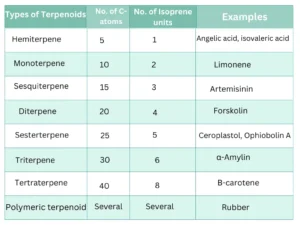
The classification of terpenoids based on the number of isoprene units involved in the formation of such organic compounds is :
isovaleric acid
limonene
diterpene
artiminsin
triterpene
ceroplastol
tetraterpene
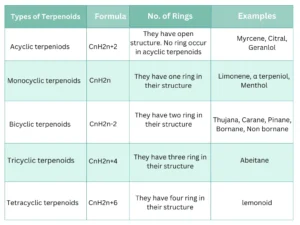
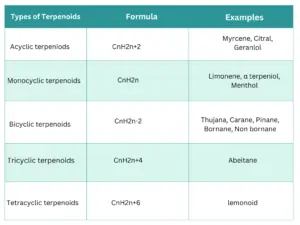
Each above class of terpenoids is further sub-classified based on the number of rings present in their structures:
citral
Fig 2.1 Monocyclic terpenoid: Menthol
abeitane
pinane
clavarnine
General methods of structure elucidation of Terpenoids
1. Molecular formula:
The molecular formula is obtained using molecular weight analysis and mass spectrometry. When a terpenoid is optically active, its specific rotation is measured.
2. Presence of oxygen:
If oxygen is present in terpenoids then it may contain functional groups such as alcohol, aldehyde, ketone, or carboxylic groups.
Confirmation of the presence of –OH group:
The presence of the –OH group is confirmed by:
Formation of acetate by acetic anhydride
Formation of benzoate by 3,5 dinitro benzoyl chloride
Confirmation of the presence of carbonyl group (>C=O) :
The terpenoids having a carbonyl functional group give crystalline addition products such as oximes, phenyl hydrazones, bisulfites, etc.
Confirmation of the presence of carboxylic acid group (–COOH) :
The presence of a carboxylic acid group in terpenoids is detected by NaHCO3.The carboxylic acid gives effervescence with NaHCO3.
3. Unsaturation:
The presence of olefinic double bonds and unsaturation in terpenoids are detected by bromination.
2. The number of double bonds is determined by catalytic hydrogenation.
3. The addition of halogen acids also determines the presence of double bonds.
4. The addition of nitrosyl chloride (Tilden’s reagent) gives an idea up to some extent the presence of double bonds in terpenoids.
5. Formation of epoxide with peracid also gives an idea about the double bonds in terpenoid molecules.
4. Dehydrogenation:
When terpenoids are dehydrogenated with Sulphur or Selenium then terpenoids are converted into aromatic compounds.
The skeleton structure and position of the side chain in the original terpenoid molecule may be detected by the examination of these products.
For example,
Para-cymene is formed on selenium dehydrogenation of α-terpinol.
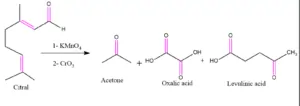
5. Oxidative degradation:
Oxidative degradation is used to detect the position of double bonds and the presence of functional groups in the terpenoid molecule.
6. Relation between the general formula of the compound and the type of compounds:
For example, Limonene (molecular formula: C10H16) absorbs 2 moles of hydrogen to produce tetrahydro limonene (molecular formula: C10H20) according to the general formula ( CnH2n ). It indicates that limonene has a monocyclic structure.
7. Spectroscopic studies:
UV spectroscopy is useful for the detection of the degree of unsaturation.
IR spectroscopy is useful for the detection of functional groups.
NMR and CMR are useful for the detection of several sets of protons and carbon atoms and finally molecular structure of a terpenoid molecule.
Mass spectra are useful for the determination of molecular weight.
8. Synthesis:
The structure of a terpenoid molecule is also confirmed by the synthesis of a known compound.
Frequently Asked Question
What are the most important terpenoids?
Some most important terpenoids are:
Monoterpenes (C-10) such as carvone, geraniol, d-limonene, and perillyl alcohol
Sesquiterpenes (C-15) such as Farnesol and Artemisinin
which are the main source of the essential oils.
While diterpenes (C-20) such as retinol, trans-retinoic acid and Forskolin
Sesterterpenes (C-25) such as geranylfarnesol, Gascardic acid
Triperpenes (C-30) such as betulinic acid, alpha-amyrin, oleanolic acid , ursolic acid, and lupeol
Tetraterpenes (C-40) such as α-carotene, β-carotene and lutein
and other terpenes are the source of balsams, resins, waxes, rubber, etc.
What is the basic unit of terpenoids?
An Isoprene unit containing five carbons in its structure is the basic unit of terpenoids.