The identification of organic compounds means working out what an unknown carbon-based substance is by running a planned series of lab tests. You observe its physical properties, detect the elements in it, sort it by solubility, find its functional group, compare your data with published values, and finally prove the identity with a derivative. Every result removes some candidates until one compound is left.
If you have ever been handed a labelled vial with nothing but a number on it, you already know the feeling. The good news is that the method is far more logical than it looks. This guide walks through it in the same order a practical exam or teaching lab expects, with what to do, what you should see, and what it means.
The Seven Steps at a Glance
| Step | What you do | What you learn |
| 1 | Preliminary examination | State, colour, odour, flame behaviour, melting or boiling point |
| 2 | Elemental analysis | Presence of nitrogen, sulphur and halogens |
| 3 | Solubility classification | The broad family the compound belongs to |
| 4 | Functional group tests | The specific reactive group |
| 5 | Literature survey | A short list of compounds that fit your numbers |
| 6 | Confirmation | A derivative or mixed melting point that settles it |
| 7 | Conclusion | A written, evidence-based answer |
This workflow suits solids and liquids alike and is the backbone of most undergraduate, pharmacy, A-Level and BS practical courses.
How Organic Analysis Differs From Inorganic Analysis
In inorganic work you chase ions, such as a copper cation or a chloride anion, and each has a signature test. Organic compounds do not behave that way. Almost all of them are assembled from the same few elements (carbon, hydrogen, oxygen, nitrogen, sulphur and the halogens), so knowing the elements only gets you part of the way. What separates ethanol from acetic acid is the functional group: the reactive corner of the molecule, such as –OH, –CHO, –COOH or –NH₂.
That is why the method is built on elimination. You begin with quick, harmless observations and only reach for specific reagents once the broad tests have narrowed things down. It saves sample, saves reagents and stops you from drawing a confident but wrong conclusion from the wrong test.
By the end of the sequence, you should be able to state which elements are present, which functional group is present, and which named compound matches both, backed by a melting or boiling point that agrees with a reference book.
Safety First: Set Up Before You Start
Assume the unknown is hazardous until you know better.
• Wear a lab coat, splash goggles and gloves. Heat and use volatile reagents inside a fume hood.
• Tollens’ reagent has to be made fresh and thrown away straight after use. Left standing, it can form explosive silver compounds.
• 2,4-Dinitrophenylhydrazine (2,4-DNP) is flammable and can be sensitive to shock when dry, so keep it moist.
• Sodium metal, needed for the fusion test, reacts violently with water. Use forceps and keep it dry.
• Bromine water and concentrated sulphuric acid burn skin. Always pour acid into water, never the other way round.
• Separate your waste (halogenated, acidic, heavy metal, oxidising) and follow your own lab’s disposal rules.
You will want test tubes and a rack, a fusion tube, a Bunsen burner, a water bath, a melting point apparatus, droppers, litmus paper, filter paper, and a notebook you are happy to get stained.
Step 1: Preliminary Examination
Before any reagent comes out, use your eyes, your nose (carefully), and a flame. This takes ten minutes and often removes half the possibilities.
Physical State
Note whether the sample is a solid or a liquid. For solids, record the crystal shape and whether it looks damp or clumps in air. Carboxylic acids, phenols, amides, sugars, and amino acids are usually solids. Small alcohols, esters, ketones and ethers are usually liquids.
Colour
| Colour | What it can suggest |
| White or colorless | Most pure organics: acids, alcohols, esters, simple amides, sugars |
| Yellow | Nitro compounds, quinones, azo compounds, conjugated systems |
| Turns brown or pink on standing | Oxidized phenols or aromatic amines |
| Deeply colored | Dyes, extended conjugation, quinones |
Odour
Fan the vapor toward your nose with your hand. Never inhale directly from the tube.
| Smell | Likely class |
| Fruity or sweet | Esters |
| Medicinal or carbolic | Phenols |
| Fishy or like ammonia | Amines |
| Sharp, like vinegar | Lower carboxylic acids |
| Bitter almonds | Benzaldehyde, nitrobenzene |
| Mothballs | Naphthalene |
Ignition Test
Hold a pinch of the sample on a spatula in a flame and watch.
| What you see | What it points to |
| Clean, pale or bluish flame | Aliphatic compound with low carbon content |
| Yellow, smoky, sooty flame | Aromatic or strongly unsaturated compound |
| Ash or residue left behind | A metal salt, or an organic salt such as a sodium carboxylate |
| Melts, then burns | Common for solid organics |
| Refuses to burn | Heavily halogenated or very oxygen-rich compound |
Melting Point or Boiling Point
This is the most valuable number you will collect. A pure solid melts over a narrow range of about one degree or less. If your range is wide and the value is lower than expected, the sample is impure, so recrystallise it before going further. Write the figure down carefully because you will lean on it in Step 5.
Step 2: Elemental Analysis
Carbon and hydrogen are assumed in an organic compound, but you can prove them by heating the sample with dry copper(II) oxide. Carbon dioxide turns lime water milky, and water vapour turns anhydrous copper sulphate blue.
Nitrogen, sulphur and halogens are harder, because they sit in covalent bonds and will not react with simple reagents. Lassaigne’s test (the sodium fusion test) solves that by converting them into ions you can detect.
Making the Lassaigne Extract
1. Melt a small, clean piece of sodium in a dry fusion tube.
2. Add a pinch of your compound and heat until the tube glows red.
3. Drop the hot tube into about 10 mL of distilled water in a china dish. Cover quickly, because it spits.
4. Break up the glass, boil, and filter. The clear alkaline filtrate is your extract.
Inside the tube, nitrogen turns into NaCN, sulphur into Na₂S and halogens into NaX.
Detecting Nitrogen
Boil a portion of the extract with freshly made iron(II) sulphate, then acidify with dilute acid and add a drop of ferric chloride. A Prussian blue colour or precipitate means nitrogen is present.
Detecting Sulphur
Add sodium nitroprusside to the extract and look for a deep violet colour. As a second check, acidify with acetic acid and add lead acetate. A black precipitate of lead sulphide confirms sulphur.
When Both Nitrogen and Sulphur Are Present
Sometimes the two combine to form sodium thiocyanate during fusion. In that case acidify with dilute HCl and add ferric chloride. A blood-red colour, from the iron thiocyanate complex, shows both elements. You will not see Prussian blue here, so do not read its absence as a negative for nitrogen.
Detecting Halogens
Acidify the extract with dilute nitric acid and boil it to drive off any hydrogen cyanide or hydrogen sulphide, which would give misleading results. Cool it and add silver nitrate.
| Precipitate | Halogen | In ammonia solution |
| White and curdy | Chlorine | Dissolves easily |
| Pale yellow | Bromine | Dissolves slightly |
| Yellow | Iodine | Does not dissolve |
The payoff is practical. Nitrogen points toward amines, amides, nitriles, nitro compounds or amino acids. Sulphur hints at thiols or thioureas. Halogens suggest alkyl or aryl halides. You have narrowed the field before opening a single functional group bottle.
Step 3: Solubility Classification
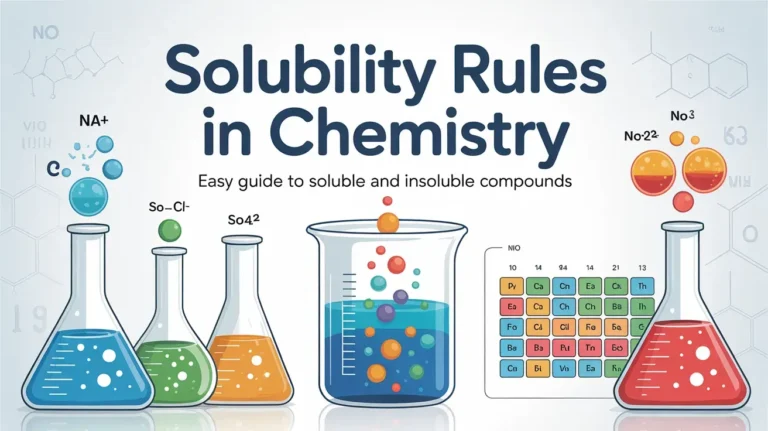
Solubility tests sort your compound into a class, using the old rule that like dissolves like. Polar compounds favour polar solvents, acids dissolve in bases, and bases dissolve in acids.
Method: Add roughly 0.1 g of solid (or 0.2 mL of liquid) to 3 mL of solvent, shake well and watch. Work through the solvents in this order:
1. Water. If it dissolves, check the solution with litmus.
2. 5% NaOH. Try this if it did not dissolve in water.
3. 5% NaHCO₃. Only for compounds that dissolved in NaOH.
4. 5% HCl. For compounds that did not dissolve in NaOH.
5. Concentrated H₂SO₄. For compounds untouched by everything above and containing no nitrogen or sulphur.
| Behaviour | Likely compounds |
| Dissolves in water, acidic to litmus | Small carboxylic acids (up to about C5) |
| Dissolves in water, basic to litmus | Small amines |
| Dissolves in water, neutral | Small alcohols, aldehydes, ketones, amides, sugars, amino acids |
| Water-insoluble, dissolves in NaOH and NaHCO₃ | Carboxylic acids |
| Water-insoluble, dissolves in NaOH only | Phenols, enols, imides |
| Dissolves in 5% HCl | Amines |
| Insoluble above, dissolves in conc. H₂SO₄ | Neutral compounds with oxygen or unsaturation: alcohols, aldehydes, ketones, esters, ethers, alkenes, alkynes |
| Insoluble even in conc. H₂SO₄ | Alkanes, alkyl halides, aromatic hydrocarbons |
Treat this table as a guide rather than a ruling. Compounds with more than one functional group, or a very large carbon skeleton, break the pattern often enough to catch careless students.
The reason a carboxylic acid dissolves in bicarbonate while a phenol does not comes down to how strong each acid is, and that in turn depends on electronic effects within the molecule. If that part feels hazy, read about acid strength, the inductive effect and the resonance effect before your next practical.
Quick Screening Tests
These fast checks help you decide which group of tests to run next.
| Test | Positive result | Suggests |
| Litmus | Blue turns red, or red turns blue | Acid or base |
| Sodium bicarbonate | Steady fizzing of CO₂ | Carboxylic acid |
| Neutral ferric chloride | Violet, blue or green colour | Phenol or enol |
| Soda lime heating | Ammonia or a hydrocarbon smell | Amide or ammonium salt; carboxylate |
| Baeyer’s test (cold, dilute KMnO₄) | Purple fades, brown MnO₂ appears | Unsaturation |
| Bromine water | Orange fades, or a white solid forms | Unsaturation; phenols and anilines |
| Molisch test | Purple ring at the interface | Carbohydrate |
The ferric chloride result for enols is a nice example of why structure matters. Enols exist in balance with their keto forms, a phenomenon explained in this overview of tautomerism.
Step 4: Functional Group Tests
Now you run targeted tests for the family you identified. One habit will save you from many mistakes: always run the same test on a known compound beside your unknown, so you can compare colour and speed directly.
Carboxylic Acids (–COOH)
| Test | What you see |
| Sodium bicarbonate | Brisk effervescence |
| Litmus paper | Blue litmus turns red |
| Esterification (add alcohol and a few drops of conc. H₂SO₄, warm) | Fruity smell |
| Neutral FeCl₃ on the sodium salt | Buff-coloured precipitate with benzoates |
Phenols (Ar–OH)
| Test | What you see |
| Neutral FeCl₃ | Violet, blue, green or red colour |
| Bromine water | White precipitate of tribromophenol, bromine colour lost |
| Solubility | Dissolves in NaOH, not in NaHCO₃ |
Alcohols (–OH)
| Test | What you see |
| Ceric ammonium nitrate | Yellow solution turns red or pink |
| Lucas test (ZnCl₂ in conc. HCl) | Tertiary: cloudy at once. Secondary: cloudy in about 5 minutes. Primary: clear at room temperature |
| Acidified K₂Cr₂O₇ or Jones reagent | Orange turns green for primary and secondary alcohols |
The Lucas test works well up to around six carbons. Larger alcohols do not dissolve in the reagent, which muddies the result.
Aldehydes and Ketones (C=O)
| Test | Aldehyde | Ketone |
| 2,4-DNP | Yellow, orange or red precipitate | Yellow, orange or red precipitate |
| Tollens’ test | Silver mirror | No reaction |
| Fehling’s test | Red Cu₂O precipitate (aliphatic) | No reaction |
| Schiff’s test | Magenta colour returns | No colour |
| Iodoform test | Only ethanal | Yellow precipitate with methyl ketones (CH₃CO–) |
Remember the division of labour. The 2,4-DNP test tells you a carbonyl group exists. Tollens’, Fehling’s and Schiff’s tests tell you whether it is an aldehyde. Aromatic aldehydes generally fail Fehling’s test.
Esters (–COOR)
Use the hydroxamic acid test. Heat the sample with hydroxylamine hydrochloride and NaOH, cool, acidify and add ferric chloride. A burgundy-red to violet colour indicates an ester, although acid chlorides and anhydrides respond too. A fruity smell backs up the result.
Carbohydrates
| Test | What you see |
| Molisch | Purple ring (all carbohydrates) |
| Fehling’s or Benedict’s | Brick-red precipitate (reducing sugars such as glucose and lactose) |
| Tollens’ | Silver mirror (reducing sugars) |
| Iodine | Blue-black colour (starch) |
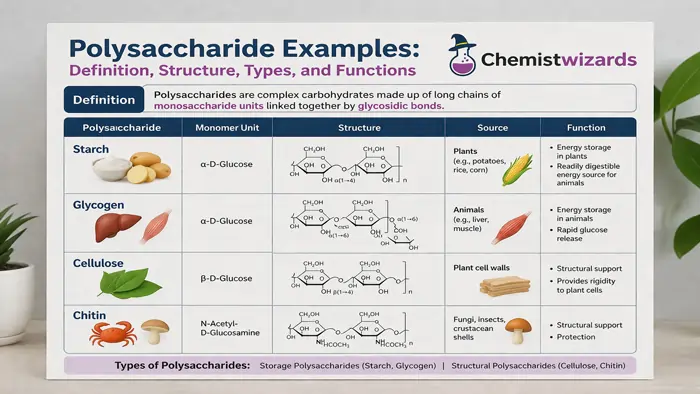
Sucrose is a non-reducing sugar. It reacts with Fehling’s or Benedict’s only after you hydrolyse it with acid. For deeper background on sugars and related molecules, the biochemistry articles are a useful companion.
Hydrocarbons
Alkenes and alkynes decolourise Baeyer’s reagent and bromine water. Aromatic hydrocarbons burn with a sooty flame and resist most reagents. Neither dissolves in water.
Ethers
Simple ethers are quiet molecules, so they are usually identified by elimination: neutral, unreactive toward most reagents, soluble in concentrated sulphuric acid, with a sweetish smell. An IR spectrum showing a C–O stretch helps support the case.
Amines
| Test | What you see |
| Litmus | Red turns blue |
| Hinsberg test (benzenesulfonyl chloride + NaOH) | Primary: clear solution that gives a precipitate on acidifying. Secondary: insoluble precipitate. Tertiary: no reaction |
| Nitrous acid test (NaNO₂ + HCl, 0–5 °C) | Aromatic primary: diazonium salt, which gives an orange-red azo dye with β-naphthol. Aliphatic primary: nitrogen gas bubbles |
| Carbylamine test | Foul smell of isocyanide from primary amines |
Amides, Imides, Nitriles, Ammonium Salts and Urea
| Group | Test | What you see |
| Amide | Boil with NaOH | Ammonia released, turns moist red litmus blue |
| Imide | Dissolves in NaOH; heat | Ammonia on prolonged heating |
| Nitrile | Nitrogen positive in fusion; hydrolyse with NaOH | Ammonia and a carboxylate form |
| Ammonium salt | Warm with NaOH | Pungent NH₃, white fumes near a rod dipped in HCl |
| Urea | Biuret test | Violet colour |
Anilides and Nitro Compounds
• Anilides: Boil with dilute HCl to release aniline, make the mixture alkaline, then run the nitrous acid and β-naphthol dye test.
• Nitro compounds: Reduce with Sn/HCl or Zn/NH₄Cl to the amine, then diazotise and couple. The Mulliken–Barker test (Zn/NH₄Cl followed by Tollens’ reagent) gives a grey-black silver deposit.
Anhydrides, Amino Acids and Quinones
• Acid anhydrides hydrolyse slowly in water and give a positive hydroxamic acid test. Phthalic anhydride also passes the fluorescein test: fuse with resorcinol and a drop of sulphuric acid, then dissolve in dilute NaOH to see green fluorescence.
• Amino acids give a purple colour with ninhydrin, dissolve in water, decompose on melting and behave as amphoteric compounds.
• Quinones are usually yellow, are reduced to colourless hydroquinones by tin(II) chloride or sodium dithionite, and can be reoxidised.
Step 5: Literature Survey
By now you have a list of elements, a solubility class, a functional group and a melting or boiling point. Take all four to the books and look for compounds that match every one of them.
• Method: Find the table for your functional group and list every compound within roughly ±3 °C of your measured value.
Write each candidate in your notebook with its literature melting or boiling point and the results you would expect from further tests. Then pick a test that can tell the remaining candidates apart. If you want one place to keep reference material while you work, the chemistry book page and the chemistry software tools at Chemist Wizards are worth bookmarking.
Step 6: Confirmation Tests
A single colour change never proves identity. Real confirmation means making a derivative or comparing the unknown with an authentic sample.
| Functional group | Typical derivative | What you compare |
| Aldehyde or ketone | 2,4-DNP hydrazone, semicarbazone, oxime | Derivative’s melting point |
| Carboxylic acid | Amide, anilide, p-toluidide | Melting point |
| Alcohol | 3,5-dinitrobenzoate, phenylurethane | Melting point |
| Phenol | Bromo derivative, aryloxyacetic acid | Melting point |
| Amine | Benzamide, acetamide, picrate | Melting point |
The derivative is a second solid with its own melting point, and the pair of numbers (original compound plus derivative) is much harder to match by accident.
Mixed melting point. Grind your unknown 50:50 with a pure sample of the suspected compound. If the mixture melts sharply at the same temperature, they are the same substance. If the melting point drops and the range widens, they are different.
Where equipment exists, you can also confirm by TLC (co-spot with a standard and look for a single spot with the same Rf) or by IR, NMR or mass spectrometry.
Step 7: Conclusion and Report
A good conclusion reads like a short argument: here is what I observed, here is what it means, and here is what the compound must be.
Worked Example
| Section | Entry |
| Appearance | White crystalline solid, no smell |
| Ignition | Sooty flame, no residue |
| Melting point | 121–122 °C |
| Elements | Nitrogen, sulphur, halogens absent |
| Solubility | Insoluble in water; dissolves in NaOH and NaHCO₃ with fizzing |
| Functional group | Carboxylic acid (CO₂ with bicarbonate; blue litmus turns red) |
| Aromatic? | Yes (sooty flame) |
| Literature match | Benzoic acid, m.p. about 122 °C |
| Confirmation | Benzanilide derivative melts near 163 °C, matching the literature; mixed melting point with authentic benzoic acid shows no depression |
| Conclusion | The unknown is benzoic acid (C₆H₅COOH). |
What separates a top report from an average one is that it explains what each result ruled out, not just which tests turned positive.
Common Mistakes and How to Avoid Them
• Starting with an impure sample. A low, wide melting range sends you to the wrong page of the reference book. Recrystallise first.
• Skipping the control. Without a known compound beside your unknown, you cannot judge whether a colour is a real positive.
• Forgetting to boil off HCN or H₂S before adding silver nitrate. This gives false halogen results.
• Getting the sodium quantity wrong in the fusion. Too little or too much can cause nitrogen to be missed or break down the thiocyanate complex.
• Using stale reagents. Mix Fehling’s A and B just before use, and make Tollens’ reagent fresh every time.
• Dirty glassware. A trace of grease or acid is enough to ruin a silver mirror or a subtle colour test.
• Trusting one test. Phenols, enols and some acids overlap in several colour tests, so always back a result with an independent second test.
Classical Tests vs Instrumental Methods
| Feature | Classical wet tests | IR, NMR and mass spectrometry |
| Cost | Very low | High equipment cost |
| Sample needed | Milligrams | Micrograms to milligrams |
| Speed | Hours | Minutes |
| Teaching value | Trains chemical reasoning | Gives definitive structure |
| Best for | Teaching labs, quick screening | Research, final proof |
Modern labs rarely pick one or the other. Wet tests narrow the functional group, and a spectrum, for instance a strong IR band near 1700 cm⁻¹ for a carbonyl, confirms the structure.
Frequently Asked Questions
What is the first step in the identification of organic compounds?
The preliminary examination. Record the state, colour, odour, ignition behaviour and melting or boiling point before any reagent is used.
Why do we perform Lassaigne’s test?
It turns covalently bound nitrogen, sulphur and halogens into cyanide, sulphide and halide ions, which can be detected with simple precipitation or colour tests.
How can you tell an aldehyde from a ketone?
Both give a positive 2,4-DNP test. Only aldehydes give a silver mirror with Tollens’ reagent, a red precipitate with Fehling’s solution (aliphatic ones) and a restored pink colour with Schiff’s reagent.
How do you tell primary, secondary and tertiary alcohols apart?
Use the Lucas test. Tertiary alcohols cloud the solution immediately, secondary ones take about five minutes, and primary alcohols stay clear at room temperature.
What does the Hinsberg test show?
It separates primary, secondary and tertiary amines by how they respond to benzenesulfonyl chloride in sodium hydroxide.
How is the identity of an organic compound confirmed?
By preparing a solid derivative and matching its melting point to the literature, by running a mixed melting point with an authentic sample, or by comparing spectra.
Can you identify an organic compound without instruments?
For common compounds, yes. A systematic sequence of physical, elemental, solubility and functional group tests, finished with a derivative, is usually enough in a teaching lab.
Key Takeaways
• Identification is a sequence, not a single test: preliminary examination, elements, solubility, functional group, literature survey, confirmation and conclusion.
• Find the elements first with Lassaigne’s test, then the functional group.
• Solubility gives you the class, and specific tests (Tollens’, Fehling’s, Lucas, Hinsberg, hydroxamic acid, ferric chloride) give you the group.
• A derivative’s melting point is the normal proof of identity.
• Use controls, work safely, and write a conclusion that explains your reasoning.