What is acid strength?

The measurement of the ability of an acid to donate its H+ ion is known as the acid strength of that acid. Those acids with strong acid strength completely dissociate in solution, whether the solution is concentrated or dilute.

For example

There are some examples of strong acids which are given below:

  • Hydrochloric acid
  • Perchloric acid
  • Nitric acid
  • Sulphuric acid

Dependence of strength of organic acid and inorganic acid:

Organic acids:

Substituent effects are the factor that affects the strength of weak organic acids.

Inorganic acids:

The oxidation state of the atom is the factor that affects the strength of weak inorganic acids.

  • The acidic strength of an acid also depends on the solvent.
  • For example, HCl is the strong acid in aqueous solution but it is a weak acid in glacial acetic acid.

Factors affecting the acid strength:

There are some factors which are given below:

Strength of the bond

The strength of the H-A bond is one of the factors that influences acid strength.

  • If the bond is weak then less amount of energy is required to break this bond. So, this is the strong acid

Polarity of the bond

  • The polarity of the H and A bond is one of the factors which affects the acid strength. If the bond is more polar, then the proton is easily lost from the molecule. So, this is a strong acid.

Periodic trend

  • Periodic trend is also the factor that affects the acid strength of the elements.

Size of the atoms

  • The size of the atoms is one of the factors which influences the acid strength. As the size of the atom increases, the bond becomes weaker. As a result, the strength of the acid increases.

Inductive effect

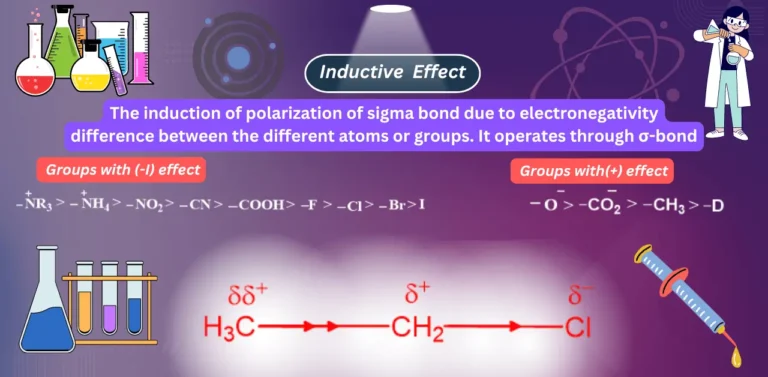
  • The inductive effect is one of the factors which affects the acid strength. For example, inorganic carboxylic acid is an electronegative substituent that pulls withdrawn electrons from the acidic bond through the inductive effect. Thus, its Pka value is decreased.

Strong acid:

An acid that is completely dissolved or dissociated in an aqueous solution, is known as a strong acid.

  • Strong acid has a more ability to lose protons
  • These have high pH values.
  • Strong acids show irreversible reactions.
  • For example, sulfuric acid, hydrochloric acid, perchloric acid, and nitric acid.

weak acid

Weak acid:

An acid that is partially ionized in an aqueous solution, is known as weak acid.

  • A weak acid can’t give many hydrogen ions in aqueous solution.
  • It has a low pH value.
  • Weak acids show a reversible reaction.
  • For example, Oxalic acid, Phosphoric acid, Nitrous acid, Formic acid, Acetic acid, and Ascorbic acid.
strong acid

video#1

https://youtu.be/9kh4MvQmMd0?feature=shared
Strong and Weak Acid Video #2
https://youtu.be/k6E3R0iG1zc?feature=shared
Effect of solvents on acid-base strength

Video#3

https://youtu.be/v_94NsuBwDM?feature=shared
Factors affecting the acid strength

Similar Posts

  • Nutraceuticals

    Nutraceuticals are the products that are derived from food sources, they have extra health benefits other than simple nutritional value. History about nutraceuticals: The term nutraceuticals combine by two words nutrient and pharmaceuticals. Nutrient mean nourishing food components and pharmaceuticals means medical drug. The name of nutraceuticals was coined by the American scientist Stephen DeFelice…

  • Steroids

    What are steroids? Classification of steroids: 1. Sterol: These core structure of steroid ( C-17) with the aliphatic side chain and one or more hydroxyl groups attached with them, these are also called steroid alcohols. Phytosterols Mycosterols Zoosterols Marine sterols Some other sterols are : Lanosterol Lupeol Oleanolic acid 2. Sex hormones: The core structure…

  • |

    Qualitative test for Carbohydrates

    Qualitative test for Carbohydrates The qualitative tests for carbohydrates such as (Molish, Benedict, Fehling, Osazone, and Barfoed tests) are used to detect the presence of reducing and non-reducing, mono and disaccharides in a sample. Here are common qualitative tests for carbohydrates: EXPERIMENTAL ANALYSIS 1. Molish Test The molish test is a simple, rapid, and chemical-sensitive…

  • |

    Cholesterol

    What is cholesterol? Structure of cholesterol: Sources of cholesterol: The main sources of cholesterol are the fish -liver oils, and the brain and spinal cord of cattle. Identification tests: Cholesterol and many other sterols gives many color reactions which are given below: When concentrated sulphuric acid is added to a solution of cholesterol in chloroform,…

  • Aromaticity rules

    Aromaticity rules in chemistry are a very fascinating concept that follows Huckle’s rule. The molecule that shows aromatic character must possess a planar, cyclic structure with a p-electron system. this system contains 4n+2π electrons. Aromaticity: The term aromaticity in chemistry tells us the stability and specific properties of many cyclic compounds having alternated double bonds….

  • Nomenclature of Alkenes; 6 Simplest IUPAC Rules

    Naming alkenes( Nomenclature of alkenes) is done by replacing ending -ane of alkanes by -ene. Like, ethane becomes ethene and soon.  International union of Pure and Applied Chemistry devised a rule for naming organic compounds through which each compound has given a specific name and with the help of this rule we can easily recognize…

Leave a Reply

Your email address will not be published. Required fields are marked *