What is the definition of Molarity?
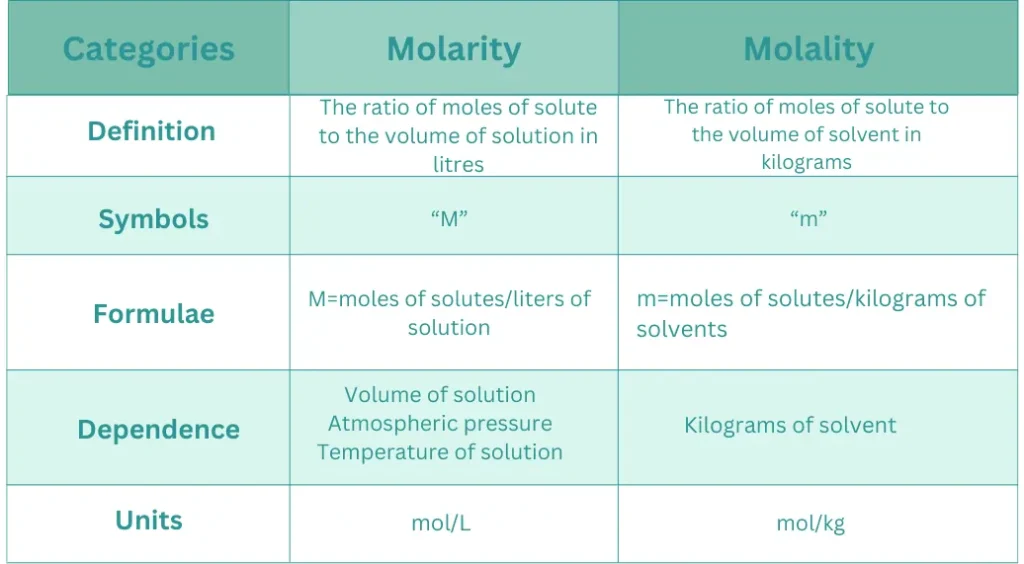
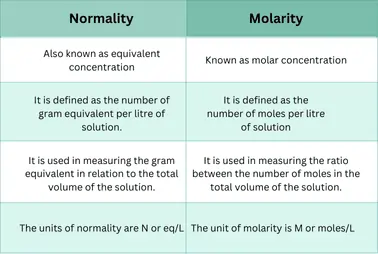
The definition of molarity is the number of moles of solute dissolved per litre/dm³ of the solution.
OR
2. Another definition of molarity is the substance per unit volume of solution.
3. Molarity is also known as the
• amount concentration
• molar concentration
• substance concentration
o It is represented as M.
Formula of Molarity
The formula of molarity is given below:

Calculating Molarity:
It can be calculated by the given equation; that is, the ratio of the moles of solute whose molarity is to be calculated and the volume of solvent is used to dissolve the given solute.

Unit of Molarity:
According to the International System of Units (SI), the unit of molarity is mol/m3.
• But the SI unit is not applicable for laboratory purposes, and most of the chemical literature uses the traditional unit that is mol/dm3 or mol/L.
• This traditional unit is mostly designated as the letter M.
• But in the SI prefix, “mega” is used for submultiples.
mol/m³ = 10⁻³ mol/dm³ = 10⁻³ mol/L = 10⁻³ M = 1 mmol/L = 1 mM
The units of millimolar and micromolar are designated as mM (10⁻³ mol/L) and µM (10⁻⁶ mol/L), respectively.
How do you find molarity step by step?
Molarity is found by dividing the number of moles of solute by the total volume of the solution in litres. This means you must first know how much solute you have and make sure the volume is measured in litres, not millilitres.
Step 1: Find the mass of the solute
Step 2: Convert that mass into moles using molar mass
Step 3: Convert the solution volume into litres
Step 4: Use the formula , where n is moles and V is litres.
For example, if you dissolve 2 moles of salt in 1 litre of solution, the molarity is 2 M. This makes molarity important in lab work, dilution, and chemical reactions because it shows the exact concentration of a solution.
Importance of Molarity
Factors That Affect Molarity
What are examples of molarity in daily life?
Frequently Asked Question Definition of Molarity
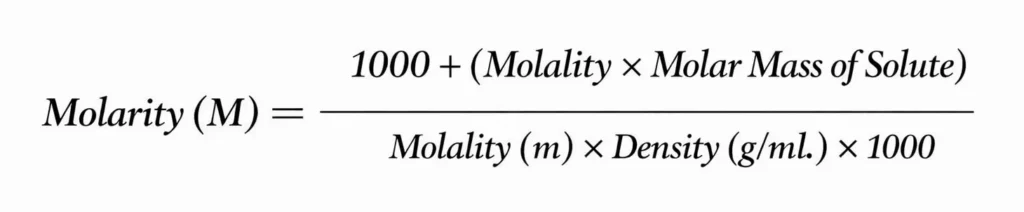
Where,
d=the density (g/ml)
m1=the molar mass of the solute
M = molarity
m=molality
The main principle of molarity is that the mole of solute and volume of solution are used. The solute is that substance of a solution that is dissolved in the solvent component. A solvent is that component of a solution that dissolves the solute.
Yes, molarity depends upon the temperature factor because volume of solution depends on temperature . As a result , molarity is also temperature dependent.
Molarity is inversely proportional to the volume of solution. So, if the volume of a solution increases, the molarity decreases and vice versa.