What is a Nucleic Acid?
Nucleic acids are large molecules found in every living organism. Cells along with proteins create nucleoproteins. The protein consists of protamines and histone proteins. Genetic data is stored in a nucleic acid molecule.
Nucleic acids are polymers of nucleotides linked by phosphodiester bonds; they are therefore called polynucleotides. There are two main types of nucleic acids:
- Deoxyribonucleic Acid (DNA).
- Ribonucleic Acid (RNA).
DNA is mainly found in the nucleus of the cell, although small amounts are also present in the mitochondria. In contrast, about 90% of RNA is located in the cytoplasm, while the remaining 10% is found in the nucleolus of the cell.
DNA structure: DNA is a double helix structure, as proposed in the Watson-Crick model of DNA structure. DNA is a double-stranded structure consisting of two strands of polydeoxyribonucleotide.
Both strands are connected by hydrogen bonds between two bases. Adenine (A) pairs with thymine (T) through two hydrogen bonds, and guanine (G) pairs with cytosine (C) through three hydrogen bonds.
This follows Chargaff’s rule, where the amount of adenine is equal to thymine (A = T) and guanine is equal to cytosine (G = C).
What is the Function of Nucleic Acids?
- DNA is the chemical basis of heredity and may be regarded as the reserve bank of genetic information.
- DNA is exclusively responsible for maintaining the identity of different species of organisms over millions of years. Further, every aspect of cellular function is under the control of DNA. The DNA is organized into genes, the fundamental units of genetic information.
- The genes control the protein synthesis through the mediation of RNA, as shown below
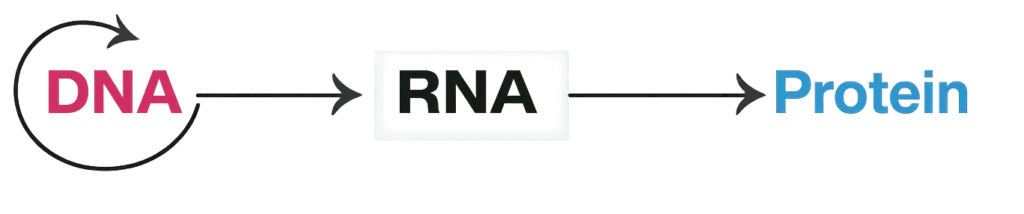
The interrelationship of these three classes of biomolecules (DNA, RNA, and
proteins) constitutes the central dogma of molecular biology or more commonly, the central dogma of life
Nucleotide
Each nucleotide consists of three components:
- A nitrogenous base
- A pentose sugar
- A phosphate group
Nitrogenous Bases of RNA and DNA
RNA and DNA contain two different types of nitrogenous bases: purines and pyrimidines. Both purines and pyrimidines are important components in the structure and function of nucleic acids.
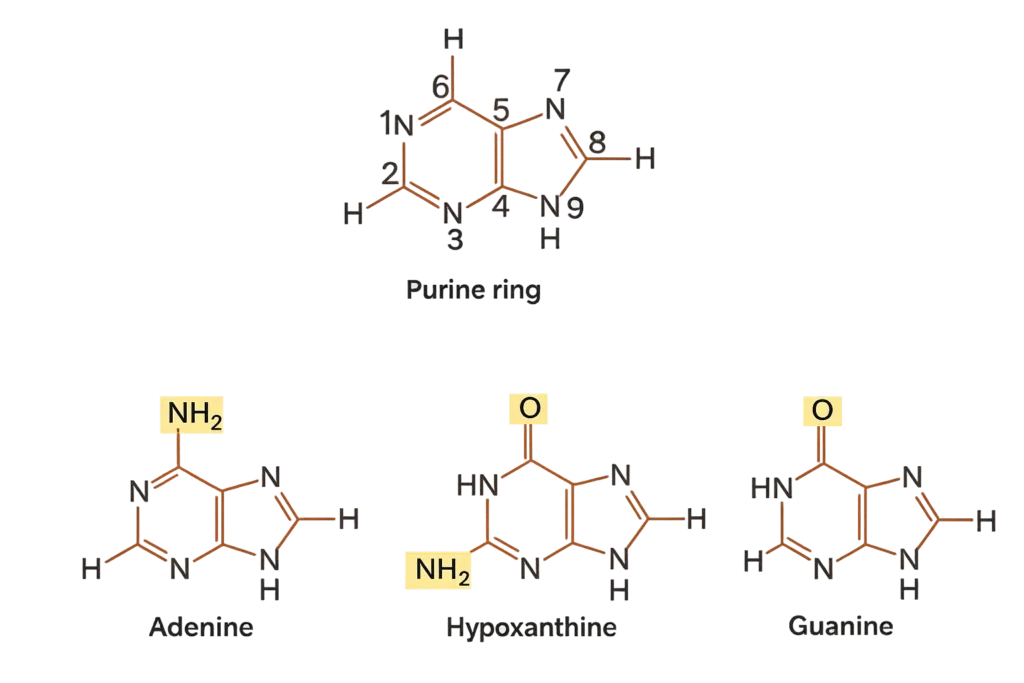
Purine Bases:
Adenine (A) and guanine (G) are two main purine bases that are found in both DNA and RNA. These purine bases are essential components of nucleic acids that play a critical role in storing genetic information.
Pyrimidine Bases:
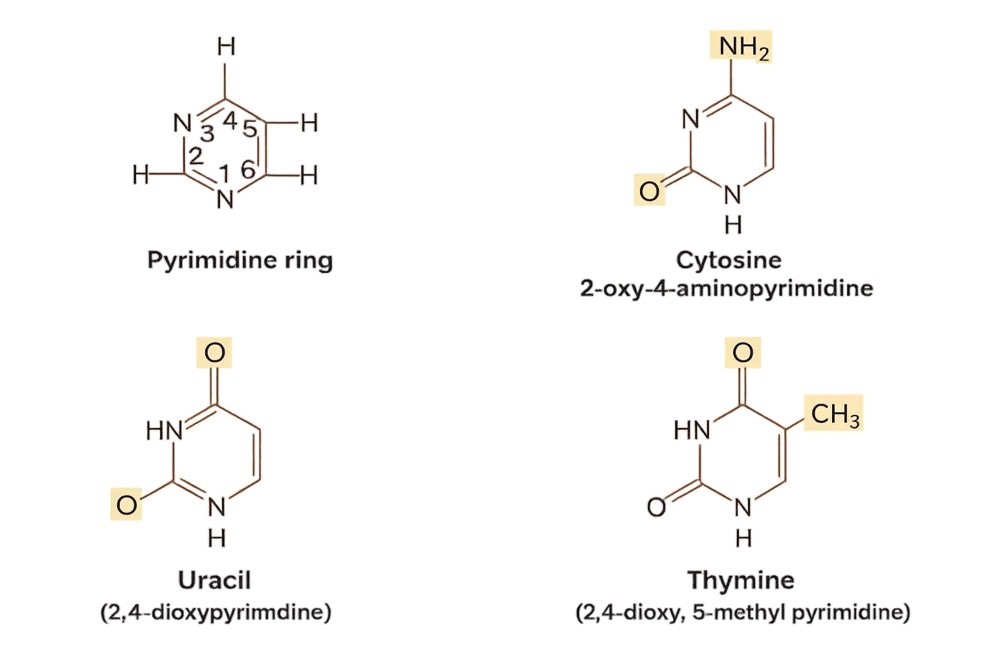
The three major pyrimidine bases are as follows:
i. Cytosine (C)
ii. Uracil (U)
iii. Thymine (T)
Cytosine and uracil are found in RNA, but cytosine and thymine are found in DNA.
Both DNA and RNA have one pyrimidine base, which is cytosine; however, they differ in their second pyrimidine base, which is thymine in DNA but uracil in RNA.
Tautomeric forms of purines and pyrimidines
When a compound exists as a keto form (lactam) and an enol form (lactim) simultaneously, the phenomenon is referred to as tautomerism. Tautomerism occurs for the heterocyclic rings of purine and pyrimidine bases that possess an oxo functional group.
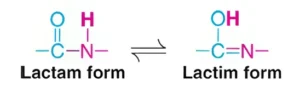
Guanine, a purine base, and the pyrimidine bases cytosine, thymine, and uracil exhibit tautomerism. These bases can be present as lactam or lactim tautomers.
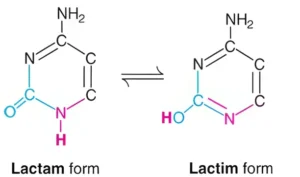
However, at physiological pH, the lactam form of these bases is the most stable form.
Pentose Sugars Present in RNA and DNA
The pentose sugar of nucleic acids is either D-ribose or D-2-deoxyribose. DNA and RNA are different from each other on the basis of the pentose sugar present in them. DNA contains D-2-deoxyribose, whereas RNA contains D-ribose.
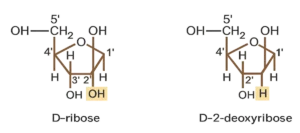
- A pentose sugar (D-ribose or D-2-deoxyribose) is linked to a nitrogenous base (purine or pyrimidine) through a covalent bond. A compound formed from a sugar and a nitrogenous base is called a nucleoside.
- The nitrogen of the nitrogenous base, i.e., either nitrogen-9 of a purine base or nitrogen-1 of a pyrimidine base, is linked to the 1′ carbon of the pentose sugar through this bond.
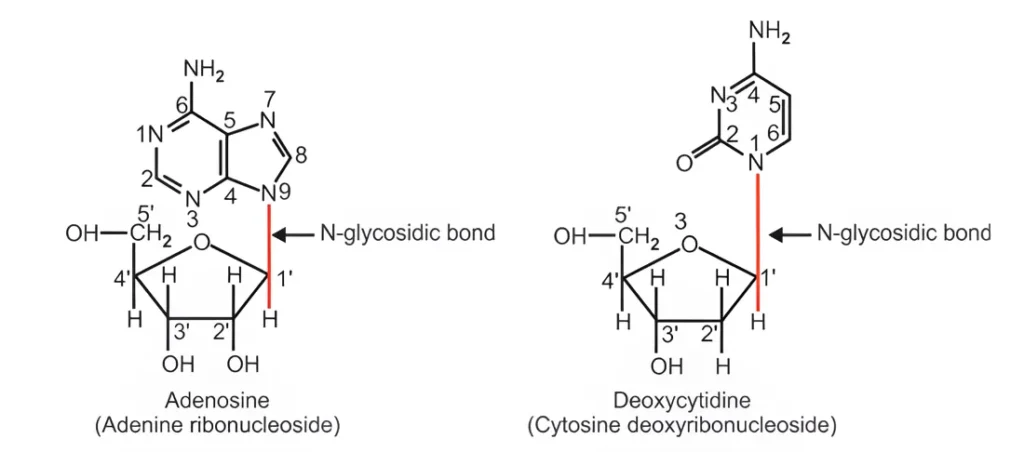
- The atoms of the nitrogenous base are given their usual numbers, while the carbon atoms of the sugar are given prime (′) numbers to indicate the difference.
The nucleosides of the bases A, G, C, T, and U are adenosine, guanosine, cytidine, thymidine, and uridine, respectively.
- If the sugar is ribose, the compound is called a ribonucleoside. If the sugar is 2-deoxyribose, the compound is called a deoxyribonucleoside. The structures of the two types of nucleosides are given.
Nomenclature of Nucleotides
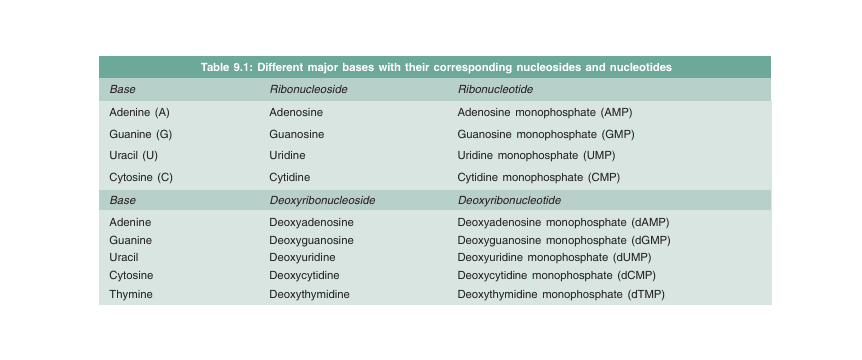
When a pentose sugar is attached to a nitrogenous base, the compound formed is called a nucleoside. If the sugar present is ribose, the resulting compounds are known as ribonucleosides. Examples include adenosine, guanosine, cytidine, and uridine, which correspond to the bases adenine (A), guanine (G), cytosine (C), and uracil (U), respectively.
If the sugar is deoxyribose, the compounds formed are called deoxyribonucleosides.
When a phosphate group is added to a nucleoside, the compound formed is called a nucleotide. The term “mononucleotide” specifically refers to a nucleotide containing one phosphate group. For example, adenosine monophosphate (AMP) consists of adenine + ribose sugar + one phosphate group.
The major bases, along with their corresponding nucleosides and nucleotides that occur in nucleic acids, are listed below. It should be noted that the prefix “d” is used to indicate the presence of deoxyribose sugar, as in dAMP (deoxyadenosine monophosphate).
Structure of nucleotides:
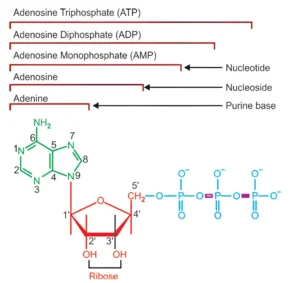
A nucleotide consists of a nucleoside with a phosphate group. A nucleoside contains a nitrogenous base and a five-carbon sugar, whereas a nucleotide contains a five-carbon sugar, a nitrogenous base, and a phosphate group. The phosphate group is joined to the hydroxyl group of the five-carbon sugar by an ester bond.
There are two kinds of nucleotides, namely, deoxyribonucleotides and ribonucleotides, based on their composition of five-carbon sugars.
Deoxyribonucleotides:
These are nucleotides that are composed of the five-carbon sugar, deoxyribose. These are monomers of DNA. These include:
Deoxyguanosine monophosphate (dGMP)
Deoxyuridine monophosphate (dUMP)
Deoxycytidine monophosphate (dCMP)
Deoxythymidine monophosphate (dTMP)
Ribonucleotides:
These are nucleotides that are composed of the five-carbon sugar, D-ribose. These are monomers of RNA.
Mononucleotides are nucleosides that are joined by one phosphate group to the hydroxyl group of their five-carbon sugar. For example, adenosine monophosphate contains adenine, ribose, and a phosphate group. When additional phosphate groups are added to one of the existing phosphate groups of a mononucleotide, nucleoside diphosphate and nucleoside triphosphate are formed. These include:
Nucleoside diphosphate, e.g., ADP
Nucleoside triphosphate, e.g., ATP
The main bases, their corresponding nucleosides, and nucleotides are the basic building blocks of nucleic acids.
Biologically Important Nucleotides
Apart from the formation of structural components of nucleic acids, several nucleotides like ATP, ADP, cAMP, GTP, GDP, cGMP, UDP, CTP, and CDP play a significant role in different biochemical processes. These nucleotides that play a significant role in different biochemical processes are called biologically important nucleotides. The role of these nucleotides in different biochemical processes is explained below.
ATP (Adenosine Triphosphate)
ATP is considered to be the main energy currency of the cell, as it supplies energy to various metabolic processes such as fatty acid synthesis, glycolysis, cholesterol synthesis, protein synthesis, and gluconeogenesis. It also plays a key role in physiological processes such as muscle contraction and nerve impulse transmission.
AMP (Adenosine Monophosphate)
AMP is a component of a number of vital coenzymes, such as NAD⁺, NADP⁺, FAD, and Coenzyme-A. All these coenzymes are vital in carbohydrate, lipid, and protein metabolism.
cAMP (Cyclic Adenosine 3′,5′-Monophosphate)
cAMP is produced from ATP through the action of the enzyme adenylate cyclase.
- It functions as a second messenger for many hormones, such as epinephrine and glucagon.
- By acting as a signaling molecule, cAMP regulates many cellular processes.
- It promotes the breakdown of stored energy sources such as fats and glycogen by stimulating lipolysis and glycogenolysis.
- It prevents platelet aggregation in the blood.
- It also increases gastric acid secretion in the stomach.
GDP and GTP (Guanosine Nucleotides)
GDP and GTP participate in several metabolic reactions.
- They are involved in the conversion of succinyl-CoA to succinate in the citric acid cycle, which is coupled with the substrate-level phosphorylation of GDP to GTP.
- GTP is required for the activation of adenylate cyclase by certain hormones.
- It also serves as an energy source during protein synthesis.
cGMP (Cyclic Guanosine 3′,5′-Monophosphate)
cGMP is synthesized from GTP by the enzyme guanylyl cyclase.
- It acts as an intracellular second messenger.
- In many cases, it acts oppositely to cAMP.
- cGMP plays a role in smooth muscle relaxation and vasodilation.
UDP (Uridine Diphosphate)
UDP participates in several metabolic pathways.
- It is involved in glycogen synthesis (glycogenesis).
- UDP-glucose and UDP-galactose are required for galactose metabolism and for the synthesis of lactose and cerebrosides.
- UDP-glucuronic acid is important in detoxification reactions and in the synthesis of mucopolysaccharides such as heparin and hyaluronic acid.
CTP (Cytidine Triphosphate) and CDP (Cytidine Diphosphate)
CTP and CDP are required for the biosynthesis of certain phospholipids.
For example, CDP-choline participates in the synthesis of sphingomyelin, an important component of cell membranes.
Frequently Asked Question about nucleic acids
What is the polymer of nucleic acids?
The polymer of nucleic acids is a polynucleotide, which is a long chain of nucleotides linked together by phosphodiester bonds. DNA and RNA are examples of these nucleotide polymers.
What are examples of nucleic acids?
The two main examples of nucleic acids are:
- DNA (Deoxyribonucleic Acid) – stores genetic information.
- RNA (Ribonucleic Acid) – helps in protein synthesis and gene expression.
What are nucleic acids monomers?
The monomers of nucleic acids are nucleotides. Each nucleotide consists of a nitrogenous base, a pentose sugar, and a phosphate group.
What do nucleic acids look like?
Nucleic acids appear as long chain molecules. DNA forms a double helix structure, while RNA usually exists as a single-stranded chain.
What are the building blocks for nucleic acids?
The building blocks of nucleic acids are nucleotides. Each nucleotide contains:
- A nitrogenous base
- A five-carbon sugar (ribose or deoxyribose)
- A phosphate group
Nucleotide vs nucleic acid
A nucleotide is a single basic unit consisting of a base, sugar, and phosphate group. A nucleic acid is a large polymer made of many nucleotides linked together, such as DNA or RNA.
What foods have nucleic acids?
Nucleic acids are present in all foods derived from living organisms, such as:
- Meat and fish
- Eggs
- Fruits and vegetables
- Beans and grains
- Nuts and seeds
Do nucleic acids contain sulfur?
No, nucleic acids normally do not contain sulfur. Their main elements are carbon (C), hydrogen (H), oxygen (O), nitrogen (N), and phosphorus (P). Sulfur is commonly found in some proteins and amino acids, not in DNA or RNA.
What are nucleoside triphosphates?
Nucleoside triphosphates (NTPs) are molecules consisting of a nitrogenous base, a sugar, and three phosphate groups. They serve as energy sources and building blocks for nucleic acid synthesis.
Examples include ATP, GTP, CTP, and UTP.
Is adenosine a nucleoside?
Yes, adenosine is a nucleoside. It is composed of the nitrogenous base adenine attached to a ribose sugar, without any phosphate group.
Is ATP a nucleoside?
No, ATP (adenosine triphosphate) is not a nucleoside. It is a nucleotide because it contains adenine, ribose sugar, and three phosphate groups.
Single nucleotide polymorphisms (SNPs)
Single nucleotide polymorphisms (SNPs) are variations in a single nucleotide in the DNA sequence among individuals. These genetic variations can influence traits, disease susceptibility, and responses to drugs.