
What Is Nitric Oxide (NO) ?
It is an inorganic diatomic molecule made up of one nitrogen and one oxygen atom joined by a double covalent bond with some triple bond nature. It is a simple molecule with the chemical formula NO and molecular weight 30.01 g/mol. It is a stable free radical, characterized by having an unpaired electron that makes it highly reactive. It rapidly reacts with oxygen in the air to form reddish-brown nitrogen dioxide (NO₂).
Brief Historical Background:
- 1620 – The first ever synthesis of nitric oxide was done by Belgian scientist Jan Baptista van Helmont
- 1772 – It was isolated by English scientist Joseph Priestley who called it “nitrous air” and reported about its reaction with air producing red fumes (NO₂).
- 1847 – The nitroglycerin, producing NO in body, with properties such as vasodilation and resulting in headaches, was discovered by Ascanio Sobrero.
- 1980s – Major scientific breakthrough. Furchgott, Ignarro, and Murad discovered that the “endothelium derived relaxing factor” (EDRF), that is responsible for relaxation of blood vessels, is nothing but NO – demonstrating for the first time that gases can function as biologically active signals.
- 1992 – NO got the status of the “Molecule of the Year” according to Science journal.
- 1998 – The Nobel prize in physiology or medicine went to Furchgott.
Physical Properties:
Appearance And Basic Properties:
Nitric oxide is a colorless gas at room temperature, with a molecular weight of 30.01 g/mol and a density of 1.34 g/L at STP.
Melting And Boiling Point:
The substance has very low melting and boiling points, −151.8°C and −163.6°C respectively. The reason for this can be attributed to the fact that it exists as a simple diatomic gas.
On cooling, it liquefies and forms a blue-colored liquid; further cooling results in it forming a bluish-white, snow-like solid state.
Critical Temperature And Pressure:
The critical temperature and critical pressure of nitric oxide are −94°C and 65 atm respectively. Beyond these values, it cannot exist as a liquid irrespective of the amount of pressure applied.
Solubility:
Nitric oxide is slightly soluble in water but highly soluble in alcohol. However, it easily passes through the cellular membrane despite its limited solubility in water.
Paramagnetism And Radical Nature:
Nitric oxide is paramagnetic due to the presence of an unpaired electron. It acts as a stable free radical.
Viscosity:
The viscosity of nitric oxide is 0.0188 cP at 25°C, showing how very easily it flows as a gas because of its low internal friction.
Refractive Index:
The refractive index of nitric oxide is 1.0002697 at 20°C and 1 atm, which is almost equal to that of air, meaning that NO hardly deviates light rays passing through it.
Heat of Vaporization:
The heat of vaporization of nitric oxide is 3.293 kcal/mol at its boiling point, indicating the low energy required to change it from liquid to gas state due to its simple and light diatomic structure.
Ionization Potential:
Its ionization potential is 9.26 – 9.27 eV, representing the energy required to remove one electron from NO – notably low, which explains why it readily loses its unpaired electron to form the NO⁺ (nitrosonium) ion in chemical reactions.
Dipole Moment:
Nitric oxide is a slightly polar molecule with a dipole moment of 0.157 D.
Even though oxygen is highly electronegative (electronegativity = 3.44) compared to nitrogen (electronegativity = 3.04), the bond dipole points from the negative oxygen ion towards the positive nitrogen ion since the lone pair is located on nitrogen.
Electronic Configuration:
NO is described using Molecular Orbital (MO) theory with the following valence shell configuration:
(σ2s)² (σ*2s)² (π2p)⁴ (σ2p)² (π*2p)¹
Orbital | Electrons | Type |
|---|---|---|
σ2s | 2 | Bonding |
σ*2s | 2 | Antibonding |
π2p | 4 | Bonding |
σ2p | 2 | Bonding |
π*2p | 1 | Antibonding (HOMO) |
The single unpaired electron in the π*2p orbital is responsible for NO’s paramagnetic nature.Having 11 valence electrons, consisting of 5 electrons contributed by nitrogen and 6 by oxygen, NO is unable to pair up all its electrons and therefore exists as a stable free radical. The odd number of electrons in the NO molecule results in a bond order of 2.5, which is somewhere between a double bond and a triple bond.
Bond Order = ½(8 − 3) = 2.5 Magnetism = Paramagnetic Ground State = X²Π
Chemical Properties:
2D And 3D Molecular Structure:
Nitric oxide represented by the formula ·N=O or N≡O, in which the dot indicates that nitric oxide contains an unpaired electron. Nitric oxide is a linear molecule with a distance between the nitrogen and oxygen atoms of around 1.15 Å. Its nitrogen-to-oxygen bond has a partial triple bond nature, which explains its bond order of 2.5.
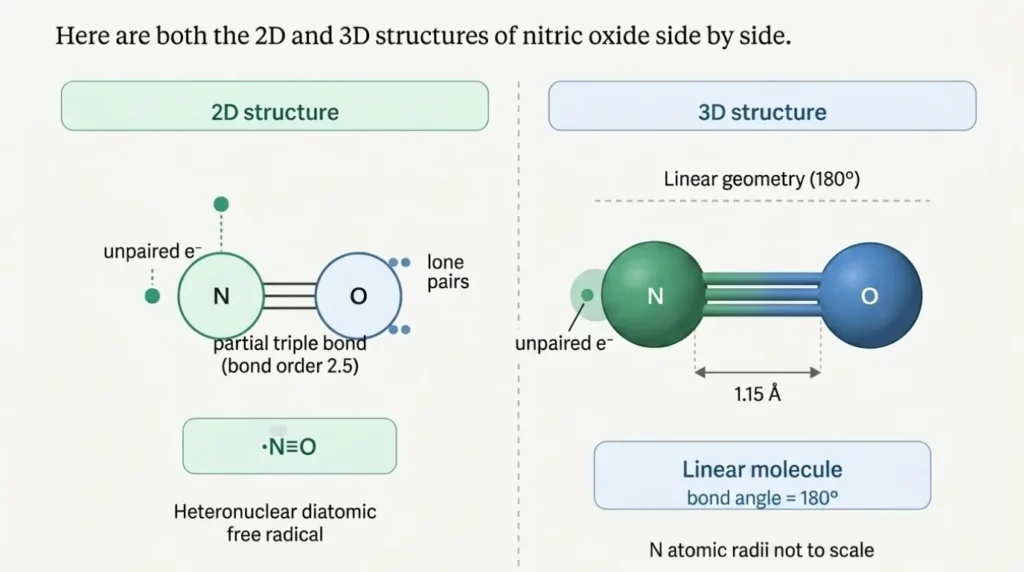
The 2D structure (left) shows NO written as ·N≡O, with the dot indicate the unpaired electron on nitrogen, three bond lines showing partial triple bond character, and lone pairs on the oxygen atom
The 3D structure (right) shows NO as a perfectly linear molecule with a bond angle of 180° and a bond length of 1.15 Å. The electron cloud on the nitrogen side illustrates where the unpaired electron density is concentrated.
IUPAC Name:
The preferred IUPAC name of NO is nitrogen monoxide.
Nitric oxide is a binary molecular compound consisting of two non-metals.
Nitrogen (N): First element
Oxygen (O): Second element, in the form of an oxide.
In binary molecular compounds, Greek prefixes are used to denote the number of atoms present in the compound.
One nitrogen atom: Prefix not given to the first element
One oxygen atom: Mono-oxide = monoxide
Therefore: NO = Nitrogen + Monoxide = Nitrogen monoxide
Molecular Formula :
Nitric Oxide has the molecular formula NO, meaning it contains one nitrogen atom covalently bonded to one oxygen atom.
Nitric oxide is a colorless gas containing an unpaired electron, thus rendering it a free radical and very reactive in various reactions.
Reactions of Nitric Oxide:
It is a highly reactive, radical molecule that quickly oxidizes to form brown nitrogen dioxide .
It plays critical roles in environmental chemistry, where it acts as a signalling molecule for vasodilation and a defense against pathogens.
Reactions with Diatomic And Triatomic Molecules:
Reaction with Oxygen (O₂):
Nitric oxide reacts rapidly with atmospheric oxygen to form reddish-brown nitrogen dioxide.
Nitrogen dioxide is an extremely common reaction of nitric oxide that occurs immediately when nitric oxide comes into contact with oxygen in the atmosphere. One example of this process includes brown fumes seen above industrial chimneys.
2NO+O2→2NO2
Reaction with Ozone (O₃):
Nitric oxide reacts vigorously with ozone in the stratosphere, splitting the ozone molecule into nitric dioxide and oxygen. The process occurs quite quickly, even in small quantities, which makes nitric oxide a powerful ozone depleter.
A typical instance involves the emission of nitric oxide from jet engines operating at high altitudes causing ozone depletion.
NO+O3→NO2+O2
Reaction with Water (H₂O):
When NO₂ – formed from NO oxidation – comes into contact with water, it disproportionates to produce nitric acid and regenerates nitric oxide. This cycle is significant in both environmental and industrial chemistry. A practical example is acid rain formation, where atmospheric nitric oxide ultimately converts to HNO₃ and falls as acidic precipitation.
Coordination complexes:
Nitric Oxide as a ligand:
The versatility of nitric oxide in acting as a ligand can be attributed to its nature of bonding through two possible forms with transition metal atoms. In the form of NO⁺ (or nitrosonium), the ligand acts as an electron donor of 3 electrons with linear geometry (with M-N-O bond angle equal to 180º).
On the other hand, when it bonds with metals as NO⁻ (or nitroxyl), it acts as an electron donor of 1 electron with bent geometry (M-N-O bond angle equal to 120º).
These two binding possibilities make nitric oxide a typical non-innocent ligand because of its varying oxidation states with the bonded metals. The bond strength between metal and NO is regulated by the back donation that takes place from the d orbitals of the metal to the π* antibonding orbital of nitric oxide.
Example:
A well-known example is sodium nitroprusside Na₂[Fe(CN)₅NO], where NO binds linearly to iron as NO⁺ and is used clinically as a vasodilator – demonstrating the direct pharmaceutical relevance of metal-NO coordination.
Production And Preparation:
Industrial methods:
Nitric oxide is produced industrially as a key intermediate in nitric acid (HNO₃) manufacturing, primarily through the Ostwald process via catalytic oxidation of ammonia.
Ostwald Process:
Ostwald process, invented by Wilhelm Ostwald, was devised in the early 20th century and remains the main industrial method for the synthesis of nitric oxide.
This method forms the basis of the industrial production of nitric acid (HNO₃) and is vital for both the fertilizer and explosives industry. Ammonia and oxygen gas from the air react in the presence of a catalyst comprising platinum and rhodium at 900°C.
The reaction is extremely exothermic and exhibits great selectivity towards NO formation provided the temperature and contact time are carefully controlled.
4NH₃ + 5O₂ →[Pt/Rh, 900°C] 4NO + 6H₂O
Catalytic Oxidation of Ammonia:
he catalytic oxidation of ammonia forms the basis of the Ostwald process, representing the most effective route available for the formation of nitric oxide from nitrogen-containing substances.
The nitrogen-containing substance ammonia (NH₃) is oxidized with atmospheric oxygen using a platinum-rhodium gauze as a catalyst. The use of the catalyst decreases the activation energy, thus ensuring that the NO molecule is produced selectively as opposed to other molecules such as N₂ or N₂O.
The reaction takes place at a temperature range of 850-950°C, ensuring that nitric oxide is produced efficiently without damaging the catalyst. The platinum-rhodium catalyst is preferred because it is resistant to high temperatures and oxidizing conditions.
4NH₃ + 5O₂ →[Pt/Rh] 4NO + 6H₂O
Laboratory methods:
In the laboratory, nitric oxide can be synthesized by chemical processes using metals and diluted nitric acid, providing an easier process than its synthesis in industry.
Copper + Dilute Nitric Acid:
The most popular synthesis of nitric oxide in laboratory conditions is by the reaction of copper with dilute nitric acid.
The reaction between these two leads to the formation of NO gas, copper nitrate, and water. In this reaction, which is carried out at room temperature, nitric oxide forms a colorless gas which quickly changes to a reddish-brown gas on contact with air.
3Cu+8HNO3(dilute)→3Cu(NO3)2+2NO↑+4H2O
Iron + Dilute Nitric Acid:
Iron reacts similarly with dilute nitric acid to produce No, though the reaction is comparatively slower than with copper.
The iron is oxidized to iron(III) nitrate while nitric acid is reduced to nitric oxide.
This method serves as a useful alternative when copper is unavailable, though careful temperature control is required to prevent formation of unwanted byproducts such as NH₄⁺ under highly dilute conditions.
Fe+4HNO3(dilute)→Fe(NO3)3+NO↑+2H2O
Other Synthesis Routes:
There are several other methods used for the synthesis of NO in laboratory setups.
One of them involves the thermal decomposition of lead nitrate that generates NO₂, which is then converted into NO through reduction processes.
The second method involves sodium nitrite and dilute H2SO4 along with FeSO4, producing NO gas under mild reaction conditions.
2NaNO2+H2SO4→Na2SO4+2NO↑+2H2O
Purification Techniques:
Once nitric oxide is produced, crude NO gas contains impurities such as NO₂, N₂O, water vapor, and unreacted ammonia, which must be removed to obtain pure NO.
Step 1 – Removal of NO₂ (NaOH scrubbing):
The gas is passed through a sodium hydroxide solution, which absorbs and neutralizes acidic NO₂ impurities.
2NO2+2NaOH→NaNO3+NaNO2+H2O
Step 2 – Removal of moisture (Desiccation):
The gas is then passed through a drying agent such as phosphorus pentoxide to eliminate water vapor, which could otherwise react with nitric oxide.
P2O5+3H2O→2H3PO4
Step 3 – Removal of unreacted ammonia (Sulfuric acid wash):
Any residual ammonia is removed by passing the gas through dilute sulfuric acid, neutralizing it as ammonium sulfate.
2NH3+H2SO4→(NH4)2SO4
Step 4 – Final collection:
Pure NO is collected by fractional distillation at low temperatures (boiling point −151.8°C) or stored in pressurized cylinders under inert conditions to prevent re-oxidation to NO₂.
2NO+O2→2NO2 (reaction to avoid)
Environmental Effects:
Nitric oxide is one of the key environmental pollutants, taking part in acid precipitation, ozone depletion, and atmospheric deterioration via a chain of complex chemical processes.
Acid Rain Deposition:
he nitric oxide released from the burning process is oxidized in the atmosphere to nitric dioxide (NO₂), which further combines with water vapor to produce nitric acid (HNO₃), an acid that is responsible for acid precipitation.
The acidic precipitation poses threats to the ecosystem and biodiversity of aquatic and terrestrial life.
3NO2+H2O→2HNO3+NO
Ozone Depletion:
he compound NO initiates the degradation of ozone in the stratosphere through a cycle reaction process where it works as a catalyst and is not depleted in the reaction
One nitric oxide molecule is capable of decomposing millions of molecules of ozone in the stratosphere.
NO + O3 → NO2 + O2
NO2 + O → NO + O2
Net: O3 + O → 2O2
Precursor to NO₂:
They oxidizes very quickly in the atmosphere to produce nitrogen dioxide (NO₂). Nitrogen dioxide is a brown, noxious gas involved in photochemical smog.
The oxidation reaction happens immediately when NO reacts with oxygen in the atmosphere.
2NO+O2→2NO2
Artificial Pollution Sources:
Anthropogenic sources that release NO gases include vehicle emissions, power plant operations, industrial boilers, and aircraft emissions.
When combustion occurs at temperatures higher than 1200°C, nitrogen and oxygen present in the atmosphere react to form NO, which is called thermal NOx production.
N₂ + O₂ (high temperature) → 2NO
Stability And Reactivity :
Toxicology :
Nitric oxide is a highly toxic gas that causes severe health complications on exposure and affects the respiratory system, cardiovascular system, and cell activity even at lower concentrations.
Non-Human Toxicity Data:
Toxic levels in animals have been set for nitric oxide exposure. Rats exposed to inhalation of nitric oxide at levels between 300-500 ppm exhibited pulmonary edema and methemoglobinemia. whereas those exposed to concentrations above 1000 ppm led to death within minutes.
For dogs, 100 ppm caused heart disease, whereas long-term exposure in rodents to 25-50 ppm resulted in irreversible lung fibrosis.
Antidote And Emergency Treatment:
The affected individual will need to be moved to a safe environment with fresh air and supplied with 100% humidified oxygen to restore the oxygen transfer process to its normal levels.
In case respiration has ceased, then immediate cardiopulmonary resuscitation should be conducted. Methylene blue (1–2 mg/kg IV) is the antidote used for treatment when methemoglobinemia is observed.
Corticosteroids and diuretics are utilized in the treatment of pulmonary edema. Water irrigation for at least 15 minutes needs to be done in case of eye or skin contact.
Uses Of NO:
Industrial Uses:
NO is mainly employed as an important raw material in the Ostwald process that is involved in the manufacture of nitric acid (HNO₃).
Nitric acid is a vital raw material in the preparation of fertilizers, explosives, and artificial fibers. Besides, it is extensively employed in the electronics industry as a processing gas in silicon nitride thin-film deposition and gate oxide formation.
Medical Uses:
Inhaled nitric oxide (iNO) is an FDA-approved treatment for persistent pulmonary hypertension in newborns, acting as a selective pulmonary vasodilator that relaxes and widens blood vessels in the lungs.
It is also used in cardiac surgery and respiratory therapy as a bronchodilator to improve oxygen delivery in critically ill patients.
Environmental Uses:
NO acts as both a calibration and reference gas in the equipment used for monitoring the environment, especially the air quality analyzing instruments that measure the concentration of pollutants in the atmosphere.
It is used in the testing of emissions from industrial facilities and vehicles.
Chemical And Research Uses:
In organic chemistry,nitric oxide acts as a reactant for nitrosation reactions that give rise to nitrosamines and other nitrogen-containing derivatives.
Laboratory Research:
In laboratory research,nitric oxide acts as a probe for understanding free radical reactions, metal nitrosyl complex chemistry, and biological signal transduction.