Molarity Calculator
You can get help online through a molarity calculator instantly and accurately. In this way, it saves your time and reduces errors. In this guide, you’ll learn what molarity means, how to perform molarity calculations, and how to use an online tool for faster results.
[molarity_calculator]
What is the definition of molarity?
1. The definition of molarity is the number of moles of solute dissolved per dm³ of the solution.
OR
2. Another definition of molarity is the substance per unit volume of solution.
Molarity is also known as the
• amount concentration
• molar concentration
• substance concentration
It is represented as 1 M.
Formula of Molarity

Units of Molarity
According to the International System of Units (SI), the unit of molarity is mol/m³.
But the SI unit is not applicable for laboratory purposes, and most of the chemical literature uses the traditional unit which is mol/dm³ or mol/L.
This traditional unit is mostly designated as the letter M.
But in SI prefixes, ‘mega’ is used for submultiples.
mol/m³ = 10⁻³ mol/dm³ = 10⁻³ mol/L = 10⁻³ M = 1 mmol/L = 1 mM
The units of millimolar and micromolar are designated as mM (10⁻³ mol/L) and µM (10⁻⁶ mol/L,) respectively.
Importance of Molarity in Chemistry and Lab Work
Molarity plays an important role in lab experiments, titrations, and solution preparation. It allows scientists and students to maintain accuracy when mixing substances. Whether you are studying chemical reactions or making standard solutions, molarity ensures consistency and precision.
What Are Molarity Calculations?
Molarity calculations are used to find how much solute is dissolved in a given volume of solution. However, this is essential for both chemical research and industrial processes.
The Basic Formula for Molarity Calculation
The formula for molarity is simple:
M = n/V
Where:
Always make sure to convert milliliters to liters when performing molarity calculations for accurate results.
How to Calculate Molarity Step by Step
Step 1: Identify Moles of Solute
The first step is to determine the moles of solute by using the formula
n=m/M
For example, if you have 10 g of NaCl (molar mass = 58.44 g/mol), the moles will be
n=10/58.44
n=0.17 moles
Step 2: Measure the Volume of Solution
The next step is to calculate the total volume of the solution in liters. If you have 500 mL of solution, convert it to liters:
V = 500 mL = 500/1000 = 0.5 L
Step 3: Apply the Molarity Formula
Now, use the main equation of the molarity formula:
Molarity = n/V
Molarity=0.17/0.5
So, your NaCl solution has a molarity of 0.342 M.
Step 4 – Example: Calculating Molarity of a Salt Solution
Suppose you dissolve 5 g of KCl (molar mass = 74.55 g/mol) in 250 mL of water.
Molarity = n / Volume of solution
As you know, n=m/Molar mass
n=5/74.55=0.067 moles
Volume in (L) = 250/1000 = 0.25 L
Molarity=0.067/0.25
Molarity = 0.268 M
Thus, the molarity of the solution is 0.268 M.
How to Calculate Concentration in Molarity
Understanding Concentration vs. Molarity
Concentration tells you how much solute is present in a solution, while molarity expresses that concentration in moles per litre. Both describe how “strong” or “weak” a solution is.
Formula to Calculate Concentration in Molarity
Use the molarity formula:
Molarity = n/V
This method works well when you want to calculate molarity from mass and volume.
Common Mistakes When Calculating Concentration
So, always double-check each value to avoid errors in your final molarity.
How Do You Calculate Molarity?
To find the molarity (the concentration of a solution), divide the moles of solute by the liters of solution. The resulting unit is moles per liter (M, or molar).
Manual Calculation Method
You can calculate molarity manually using the formula, a calculator, and proper unit conversions. This supports you to understand each step clearly, but it can be time-consuming.
Using a Molarity Calculator for Quick Results
With the help of a molarity calculator, you can get quick results for your solutions. You just enter the mass, molar mass, and volume, and it quickly gives the result. You can even calculate molarity online without installing any software.
How Do We Calculate Molarity in the Lab?
In labs, scientists weigh the solute precisely, measure the solvent using volumetric flasks, and then apply the molarity formula. For accuracy, temperature and pressure are often kept constant during molarity calculation.
Using a molarity calculator
The chemist wizard’s molarity calculator is a digital tool that is used to determine the molarity quickly. So, the molarity calculator computes the concentration of a solution when you provide mass, molecular weight, and volume.
How to Use the Molarity Calculator Step by Step
i) Enter the mass of solute (in grams).
ii) Add the molar mass (g/mol).
iii) Add the volume of the solution (in L or mL).
iv) Tap on ‘Calculate’ to get your result in mol/L.
You can also find molarity from mass and volume directly with these calculators.
Benefits of Using an Online Molarity Calculator
Let’s you perform molarity from mass conversions quickly
Tips for Accurate Molarity Calculation
Measuring Volume and Mass Correctly: Always use precise measuring tools. Small errors in volume or mass can affect your final molarity result.
Temperature and Unit Consistency: Since temperature can expand or contract liquids, always measure at standard room conditions. Keep all your units consistent, like grams for mass and litres for volume.
Double-Checking Your Results: Always remember! Double-check each step after calculating, or use a molarity calculator online to confirm your result. It is because precision matters, especially for lab and chemical reactions.
Conclusion
Thus, it is concluded from the above discussion that understanding the performance of molarity calculations is essential in chemistry. Whether you’re working in a lab or studying reactions, knowing how to calculate molarity, find molarity from mass and volume, or calculate moles from molarity confirms precision and confidence.
If you are in doubt, you can always calculate molarity online using a free and reliable molarity calculator, the simplest way to get accurate results every time.
FAQs on Calculating Molarity (Chemist Wizards)
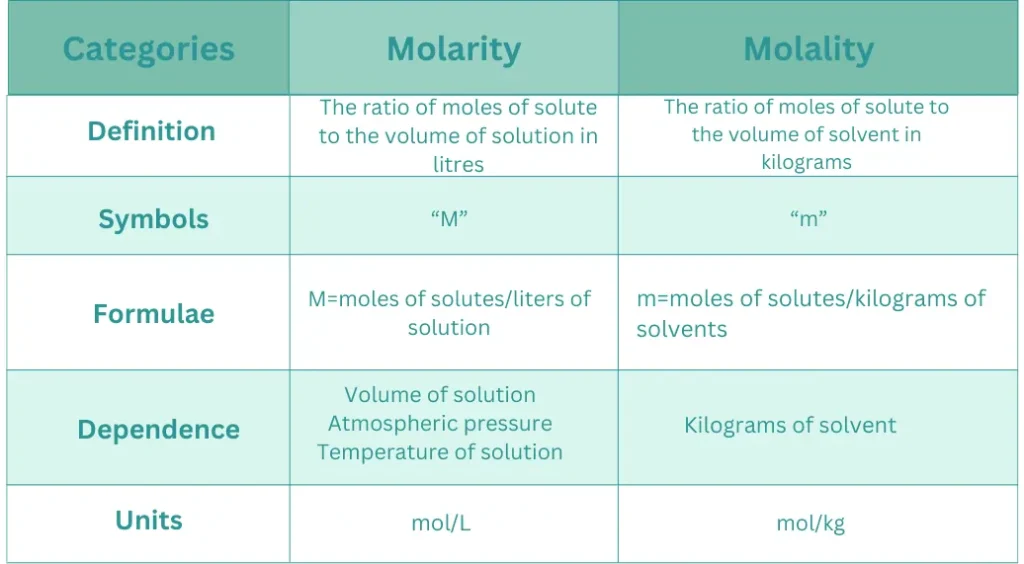
Yes, molarity depends upon the temperature factor because the volume of the solution depends on temperature. As a result, molarity is also temperature dependent.
Divide the number of moles of solute by the volume of the solution in litres using the formula:
M=n/V.
Use the dilution formula M1V1=M2V2
The easiest way is to use an online molarity calculator that automatically computes results from your entered values.
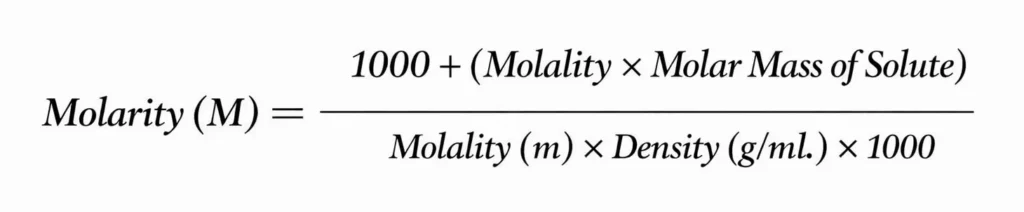
Their relationship is mentioned below:
Where,
d = the density (g/ml)
m = the molar mass of the solute
M=molarity
m=molality
The main principle of molarity is that a mole of solute and the volume of solution are used. The solute is the substance of a solution which is dissolved in the solvent component. A solvent is that component of a solution that dissolves the solute.
Molarity is inversely proportional to the volume of solution. So, if the volume of a solution increases, the molarity decreases and vice versa.