Gaussian Software Free Download Updated Version 2025
Gaussian 16 is the latest version of the Gaussian series of electronic structure programs, used by chemists, chemical engineers, biochemists, physicists, and other scientists worldwide. Gaussian 16 provides a wide-ranging suite of the most advanced modeling capabilities available. You can use it to investigate the real-world chemical problems that interest you, in all of their complexity, even on modest computer hardware. Starting from the fundamental laws of quantum mechanics, Gaussian software 16 predicts the energies, molecular structures, vibrational frequencies, and molecular properties of compounds and reactions in a wide variety of chemical environments. Gaussian 16’s models can be applied to both stable species and compounds that are difficult or impossible to observe experimentally, whether due to their nature (e.g., toxicity, combustibility, radioactivity) or their inherent fleeting nature (e.g., short-lived intermediates and transition structures). Gaussian 16 can predict a variety of spectra, in both the gas phase and in solution, including IR and Raman, NMR spectra and spin-spin coupling constants, vibrational circular dichroism (VCD), Raman optical activity (ROA), resonance Raman, UV/Visible, vibronic absorption and emission spectra for excited states via Franck-Condon and/or Herzberg-Teller analysis, electronic circular dichroism (ECD) and circularly polarized luminescence (CPL), optical rotatory dispersion (ORD), and hyperfine (microwave spectroscopy). Anharmonic analysis is available for IR, Raman, VCD, and ROA spectra.
Download
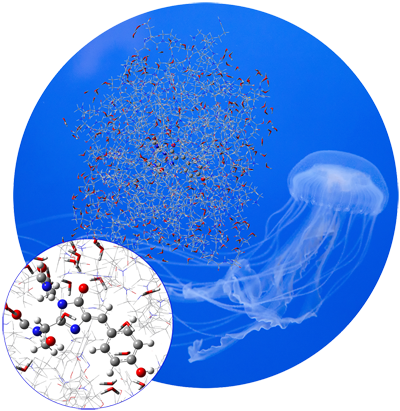
Continuing the nearly 40-year tradition of the Gaussian series of electronic structure programs, Gaussian 16 offers new methods and capabilities that allow you to study ever larger molecular systems and additional areas of chemistry. GaussView 6 offers a rich set of building and visualization capabilities. We highlight some of the most important features on this page. GFP is a protein that fluoresces bright green when exposed to light in the blue-to-ultraviolet range. The chromophore is shown in the inset below. The molecule was first isolated in the jellyfish species Aequorea victoria, which is native to the Pacific Northwest coast of North America. Since then, it has been studied extensively, and variants of the molecule with enhanced fluorescence properties have been engineered.GFP consists of a chromophore within a protein chain composed of 238 amino acids. The isolated chromophore is not fluorescent, so modeling it in its protein environment is essential. GFP’s fluorescence cycle involves an initial excitation to its first excited state, a proton transfer reaction on the S1 potential energy surface, and finally a relaxation back to the ground state.
The following features of Gaussian software 16 and GaussView 6 are useful for modeling fluorescence in this compound. GaussView can directly open files from the Protein Data Bank (PDB files). It can add hydrogens to the retrieved structure when imported or at a later time. You can also view, manipulate, and modify the structure using the PDB chain, residue type and/or number, and other PDB substructure information present in the original file. Residue and other information can be retained throughout molecule editing and job execution.
The molecule can be modeled via MO:MM calculations using Gaussian’s ONIOM facility:
GaussView makes it easy to define ONIOM layers based on many different criteria. For this molecule, assigning atoms by PDB residue is often the most straightforward.
GaussView identifies molecular mechanics atom types and partial charges automatically in most cases. It is also simple to locate atoms missing types and to specify/modify types and charges as desired. Gaussian incorporates standard MM parameters for Amber and other force fields and also allows you to define MM parameters as needed.
Gaussian’s ONIOM electronic embedding feature includes all of the effects of the protein environment without neglecting terms in the MM coupling with the chromophore QM treatment.
The molecule can be modeled via MO:MM calculations using Gaussian’s ONIOM facility:
Explicit solvent molecules can be included in the calculation (e.g., water molecules above).
GaussView can directly open files from the Protein Data Bank (PDB files). It can add hydrogens to the retrieved structure when imported or at a later time. You can also view, manipulate, and modify the structure using the PDB chain, residue type and/or number, and other PDB substructure information present in the original file. Residue and other information can be retained throughout molecule editing and job execution.
Gaussian’s ONIOM electronic embedding feature includes all of the effects of the protein environment without neglecting terms in the MM coupling with the chromophore QM treatment.
Gaussian software 16 Features at a Glance
Features introduced since Gaussian software 09 Rev A are in blue.
Existing features enhanced in Gaussian 16 are in green.
Fundamental Algorithms
Calculation of one- & two-electron integrals over any contracted gaussian functions
Conventional, direct, semi-direct and in-core algorithms
Linearized computational cost via automated fast multipole methods (FMM) and sparse matrix techniques
Harris initial guess
Initial guess generated from fragment guesses or fragment SCF solutions
Density fitting and Coulomb engine for pure DFT calculations, including automated generation of fitting basis sets
DOUBLE HYBRID: B2PLYP & mPW2PLYP and variations with dispersion, DSDPBEP86, PBE0DH, PBEQIDH (see also below in “Electron Correlation”)
EMPIRICAL DISPERSION: PFD, GD2, GD3, GD3BJ
FUNCTIONALS INCLUDING DISPERSION: APFD, B97D3, B2PLYPD3
LONG RANGE-CORRECTED: LC-ωPBE, CAM-B3LYP, ωB97XD and variations, Hirao’s general LC correction
Larger numerical integrations grids
Electron Correlation:
All methods/job types are available for both closed and open shell systems and may use frozen core orbitals; restricted open shell calculations are available for MP2, MP3, MP4 and CCSD/CCSD(T) energies.
MP2 energies, gradients, and frequencies
Double hybrid DFT energies, gradients and frequencies, with optional empirical dispersion (see list in “Density Functional Theory” above)
CASSCF calculations with MP2 correlation for any specified set of states
Effective Core Potentials (through second derivatives): LanL2DZ, CEP through Rn, Stuttgart/Dresden
Support for basis functions and ECPs of arbitrary angular momentum
DFT FITTING SETS: DGA1, DGA1, W06, older sets designed for SVP and TZVP basis sets; auto-generated fitting sets; optional default enabling of density fitting
Geometry Optimizations and Reaction Modeling
Geometry optimizations for equilibrium structures, transition structures, and higher saddle points, in redundant internal, internal (Z-matrix), Cartesian, or mixed internal and Cartesian coordinates
GEDIIS optimization algorithm
Redundant internal coordinate algorithm designed for large system, semi-empirical optimizations
Newton-Raphson and Synchronous Transit-Guided Quasi-Newton (QST2/3) methods for locating transition structures
IRCMax transition structure searches
Relaxed and unrelaxed potential energy surface scans
Implementation of intrinsic reaction path following (IRC), applicable to ONIOM QM:MM with thousands of atoms
Optimization of conical intersections via state-averaged CASSCF
Generalized internal coordinates for complex optimization constraints
Vibrational Frequency Analysis
Vibrational frequencies and normal modes (harmonic and anharmonic), including display/output limiting to specified atoms/residues/modes (optional mode sorting)
Restartable analytic HF and DFT frequencies
MO:MM ONIOM frequencies including electronic embedding
Analytic Infrared and static and dynamic Raman intensities (HF & DFT; MP2 for IR)
Pre-resonance Raman spectra (HF and DFT)
Projected frequencies perpendicular to a reaction path
NMR shielding tensors & GIAO magnetic susceptibilities (HF, DFT, MP2) and enhanced spin-spin coupling (HF, DFT)
Vibrational circular dichroism (VCD) rotational strengths (HF and DFT; harmonic and anharmonic)
Dynamic Raman Optical Activity (ROA) intensities (harmonic and anharmonic)
Raman and ROA intensities calculated separately from force constants in order to use a larger basis set
Harmonic vibration-rotation coupling
Enhanced anharmonic vibrational analysis, including IR intensities, DCPT2 & HDCPT2 method for resonance-free computations of anharmonic frequencies
Anharmonic vibration-rotation coupling via perturbation theory
Hindered rotor analysis
Molecular Properties
Population analysis, including per-orbital analysis for specifed orbitals: Mulliken, Hirshfeld, CM5
Computed atomic charges can be saved for use in a later MM calculation
Electrostatic potential, electron density, density gradient, Laplacian, and magnetic shielding & induced current densities over an automatically generated grid
Multipole moments through hexadecapole
Biorthogonalization of MOs (producing corresponding orbitals)
ONIOM integration of electric and magnetic properties
ONIOM Calculations
Enhanced 2 and 3 layer ONIOM energies, gradients and frequencies using any available method for any layer
Optional electronic embedding for MO:MM energies, gradients and frequencies implemented so as to include all effects of the MM environment without neglecting terms in its coupling with the QM region
Enhanced MO:MM ONIOM optimizations to minima and transition structures via microiterations including electronic embedding
Support for IRC calculations
ONIOM integration of electric and magnetic properties
Excited States
ZINDO energies
CI-Singles energies, gradients, & freqs.
Restartable time-dependent (TD) HF & DFT energies, gradients and frequencies. TD-DFT can use the Tamm-Dancoff approximation.
SAC-CI energies and gradients
EOM-CCSD energies and gradients (restartable); optionally input amplitudes computed with a smaller basis set
Franck-Condon, Herzberg-Teller and FCHT analyses
Vibronic spectra including electronic circular dichroism (ECD) rotational strengths (HF and DFT)
Resonance Raman spectra
Ciofini’s excited state charge transfer diagnostic (Dct)
Caricato’s EOMCC solvation interaction models
CI-Singles and TD-DFT in solution
State-specific excitations and de-excitations in solution
An energy range for excitations can be specified for CIS and TD excitation energies
Self-Consistent Reaction Field Solvation Models
New implementation of the Polarized Continuum Model (PCM) facility for energies, gradients and frequencies
Solvent effects on vibrational spectra, NMR, and other properties
Solvent effects for ADMP trajectory calcs.
Solvent effects for ONIOM calculations
Enhanced solvent effects for excited states
SMD model for ΔG of solvation
Other SCRF solvent models (HF & DFT): Onsager energies, gradients and freqs., Isodensity Surface PCM (I-PCM) energies and Self-Consistent Isodensity Surface PCM (SCI-PCM) energies and gradients
Ease-of-Use Features
Automated counterpoise calculations
Automated optimization followed by frequency or single point energy
Ability to easily add, remove, freeze, differentiate redundant internal coords.
Simplified isotope substitution and temperature/pressure specification in the route section
Optimizations
Retrieve the nth geometry from a checkpoint file
Recompute the force constants every nth step of a geometry optimization
Reduce the maximum number of allowed steps, including across restarts
180° flips detected and suppressed for better visualization
Freezing by fragment for ONIOM optimizations
Simplified fragment definitions on molecule specifications
Many more restartable job types
Atom freezing in optimizations by type, fragment, ONIOM layer and/or residue
%OldChk Link 0 command specifies read-only checkpoint file for data retrieval
Default.Route file for setting calculation defaults
Enhanced set of equivalent Default.Route directives, Link 0 commands, command line options and environment variables
Integration with External Programs
NBO 6
COSMO/RS
AIMPAC WfnX files
Antechamber
ACID
Pickett’s program
DFTB input file
General external interface script-based automation, results post-processing, interchanging data/calculation results with other programs, and so on:
Interface routines in Fortran, Python and Perl (open source)
Computer Requirements: UNIX, Linux, macOS
Important Notes for All Gaussian Binary Versions: • Beginning with Revision C.01, Linda 9.2 is required for network parallel use of Gaussian 16. Earlier versions of Linda are incompatible. Thus, upgrading from Gaussian 16 Rev. A.03 or B.01 w/Linda to G16 Rev. C.01 or C.02 w/Linda or G16 Rev. C.02 w/Linda requires an update to Linda 9.2. • The Linux RedHat and SuSE versions specified for x86_64, IA32, and IBM Power systems refer only to the unmodified, unpatched original media/ISO image distributions as released by the vendor. Revision C.01 x86_64 AVX-enabled Binary Version: • The AMD/Intel x86_64 AVX-enabled binary version includes GPU support for NVIDIA K40, K80, P100, and V100 boards with 12 GB of memory or higher. A version of NVIDIA drivers compatible with CUDA 10.0 is required to run on these GPUs with this binary version. (NVIDIA drivers can be found at www.nvidia.com/download/index.aspx).
Downlaod The File Gaussian Software
Download Gaussian Software for advanced molecular modeling and quantum chemistry calculations. It enables accurate simulations of molecular properties, reactions, and spectroscopy for cutting-edge research.