RNA Structure Definition Biology
RNA is a polymer of ribonucleotides held together by 3′,5′-phosphodiester
bridges. The RNAs are single stranded. RNA is an unbranched linear polymer of ribonucleotides joined by 3’, 5’ phosphodiester bonds. The phosphodiester bonds join the 3’-OH group of ribose of one nucleotide unit to the 5’-OH group of ribose sugar of the next nucleotide.
DNA vs RNA Structure:
1. Sugar Component
- RNA: Contains ribose sugar, which has an extra hydroxyl (–OH) group at the 2′ position.
- DNA: Contains deoxyribose sugar, which lacks the 2′ hydroxyl group.
2. Nitrogenous Bases
- RNA: Has uracil (U) instead of thymine.
- DNA: Contains thymine (T) instead of uracil.
3. Base Pairing
- RNA: Adenine pairs with uracil (A–U).
- DNA: Adenine pairs with thymine (A–T), and guanine pairs with cytosine (G–C).
4. Structure (Strands)
- RNA: Usually single-stranded, but can fold into double-stranded regions due to internal base pairing.
- DNA: Always double-stranded, forming a stable double helix.
5. Chargaff’s Rule
- RNA: Does not follow Chargaff’s rule (no fixed ratio of purines to pyrimidines).
- DNA: Follows Chargaff’s rule, meaning adenine = thymine and guanine = cytosine.
6. Stability and Chemical Reactivity
- RNA: Less stable and easily hydrolyzed by alkali due to the 2′-OH group.
- DNA: More stable and resistant to alkali hydrolysis because it lacks the 2′-OH group.
7. Shape and Folding
- RNA: Can fold into complex shapes and secondary structures.
- DNA: Maintains a consistent double helical structure.
8. Chemical Test (Orcinol Reaction)
- RNA: Gives a positive orcinol test due to ribose.
- DNA: Does not react in the same way because it contains deoxyribose.
9. Function Of DNA And RNA Structure
- RNA: Involved in protein synthesis (mRNA, tRNA, rRNA) and other cellular activities.
- DNA: Stores and transmits genetic information.
Types Of RNA:
Cell contains three major types of RNA:
- Messenger RNA (mRNA)
- Transfer RNA (tRNA)
- Ribosomal RNA (rRNA).
All of these are involved in the process of protein biosynthesis. Each differs from the others by size and functions.
RNA is made from DNA and helps the cell produce proteins in a simple and essential way
Messenger RNA (mRNA):
mRNA (Messenger RNA)
1. Synthesis of mRNA
- In eukaryotic cells, mRNA is formed in the nucleus as heterogeneous nuclear RNA (hnRNA).
- hnRNA undergoes processing to produce functional mRNA.
- The mature mRNA then moves to the cytoplasm for protein synthesis.
2. Molecular Weight and Half-life
- mRNA generally has a high molecular weight.
- It usually has a short half-life.
- However, eukaryotic mRNA is more stable and has a longer half-life compared to prokaryotic mRNA.
3. 5′ Cap Structure
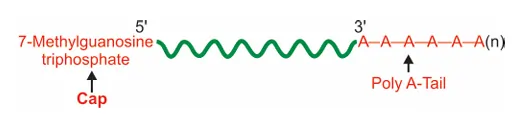
- The 5′ end of eukaryotic mRNA contains a 7-methylguanosine triphosphate cap.
- Functions of the cap:
- Protects mRNA from degradation by 5′-exonucleases
- Helps in recognition of mRNA during protein synthesis
4. 3′ Poly (A) Tail
- The 3′ end has a poly (A) tail made up of 20–250 adenine nucleotides.
- Functions of the poly (A) tail:
- Provides stability to mRNA
- Protects it from 3′-exonuclease attack
5. Modified Bases in mRNA
- mRNA may contain modified bases, such as 6-methyladenylate, within its structure.
Function of mRNA:
mRNA acts as a template for protein synthesis and carries genetic information from DNA to the protein-making machinery of the cell. If an mRNA codes for only one protein, it is called monocistronic. If it codes for two or more proteins, it is known as polycistronic. In eukaryotic cells, most mRNAs are monocistronic.
Transfer RNA (tRNA):
Transfer RNA (tRNA), also known as soluble RNA, is a small molecule made up of about 71–80 nucleotides (usually around 75) and has a molecular weight of approximately 25,000. There are at least 20 different types of tRNA, each corresponding to one of the 20 amino acids found in proteins. The structure of tRNA (for alanine) was first explained by Holley.
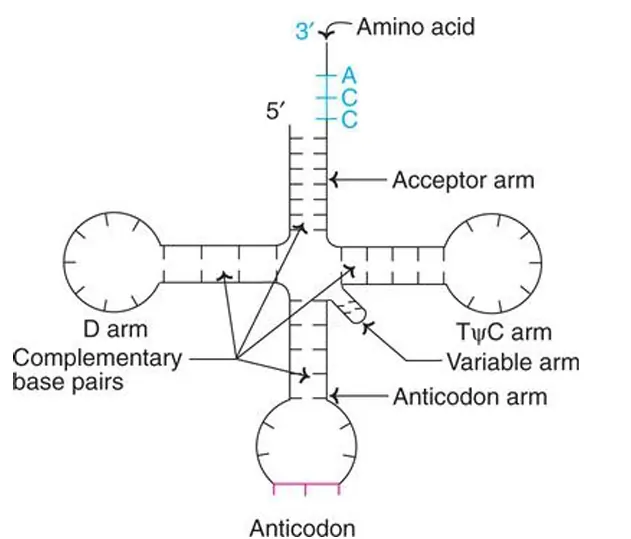
The structure of tRNA looks like a cloverleaf. It mainly has four arms, and each arm contains a stem formed by base pairing.
Acceptor arm: This arm ends with the sequence CCA (from 5′ to 3′). The amino acid attaches to this arm.
Anticodon arm: This arm has three specific bases called the anticodon, which recognizes the codon (triplet) on mRNA. The codon and anticodon are complementary to each other.
D arm: It is named because it contains dihydrouridine.
TψC arm: This arm contains the sequence thymine (T), pseudouridine (ψ), and cytosine (C).
Variable arm: This is the most variable part of tRNA. Based on its length, tRNA is divided into two types:
- Class II tRNA: Has a longer arm with 13–20 base pairs.
- Class I tRNA: The most common type (about 75%), with a short arm of 3–5 base pairs.
Base pairs in tRNA:
The structure of tRNA is maintained due to the complementary base pairing in the arms. The four arms with their respective base pairs are given below.
- The acceptor arm – 7bp
- The TψC arm – 5bp
- The anticodon arm – 5bp
- The D arm – 4bp
Function of tRNA:
tRNA carries amino acids in an activated form to the ribosome for the protein synthesis.
Ribosomal RNA (rRNA):
Ribosomal RNA (rRNA) is the type of RNA found in ribosomes.
Ribosomes are structures present in the cytoplasm that act as the cell’s machinery for making proteins. They are roughly spherical in shape and are made up of two parts: a large subunit and a small subunit, both composed of RNA and proteins.
In eukaryotic cells, ribosomes consist of a 60S large subunit and a 40S small subunit. Each of these subunits contains one or more strands of rRNA along with many protein molecules.
The 60S subunit includes 28S rRNA, 5S rRNA, and 5.8S rRNA, while the 40S subunit contains 18S rRNA.
Functions of ribosomal RNA:
The function of the ribosomal RNA molecules in the ribosomal particle are not fully understood, but they are:
- Necessary to maintain ribosomal structure and also
participate in protein synthesis by binding of mRNA
to ribosome. - Recent studies suggest that ribosomal RNAs may
also provide some of the catalytic activities and thus
is an enzyme “a ribozyme”.
Other Nuclear and Cytoplasmic RNAs:
Besides mRNA, tRNA, and rRNA, eukaryotic cells also contain several other types of RNA. These include heterogeneous nuclear RNAs (hnRNAs), small cytoplasmic RNAs (scRNAs), and small nuclear RNAs (snRNAs).