What is Electronegativity?
“The tendency of an atom in a molecule to attract the shared pair of electrons towards itself is known as electronegativity.”
It is a dimensionless property because it is only a tendency. It basically indicates the net result of the tendencies of atoms in different elements to attract the bond-forming electron pairs. We measure electronegativity on several scales. The most commonly used scale was designed by Linus Pauling.
Moreover, electronegativity differs from electron affinity because electron affinity is the actual energy released when an atom gains an electron. Electronegativity is not measured in energy units, but instead a relative scale.
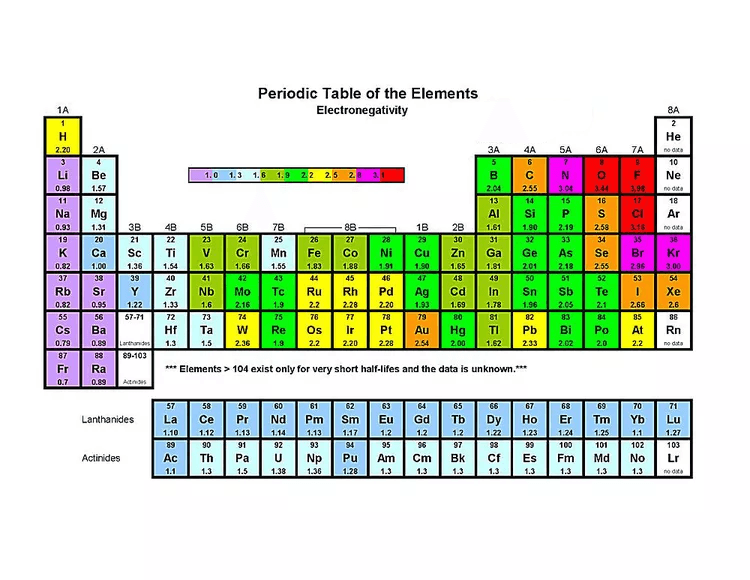
All elements are compared to one another, with the most electronegative element, fluorine, being assigned an electronegativity value of 3.98. Fluorine attracts electrons better than any other element. The table below shows the electronegativity values for the elements.
Methods of Calculation
Pauling Electronegativity
Pauling first proposed the concept of electronegativity in 1932 to explain why the covalent bond between two different atoms (A–B) is stronger than the average of the A–A and the B–B bonds. According to valence bond theory, of which Pauling was a notable proponent, this “additional stabilization” of the heteronuclear bond is due to the contribution of ionic canonical forms to the bonding.
The difference in electronegativity between atoms A and B is given by:
where the dissociation energies, Ed, of the A–B, A–A and B–B bonds are expressed in electronvolts, the factor (eV)−1⁄2 being included to ensure a dimensionless result. Hence, the difference in Pauling electronegativity between hydrogen and bromine is 0.73 (dissociation energies: H–Br, 3.79 eV; H–H, 4.52 eV; Br–Br 2.00 eV)
As only differences in electronegativity are defined, it is necessary to choose an arbitrary reference point to construct a scale. Hydrogen was chosen as the reference, as it forms covalent bonds with a large variety of elements: its electronegativity was fixed first at 2.1, later revised to 2.20.
It is also necessary to decide which of the two elements is the more electronegative (equivalent to choosing one of the two possible signs for the square root). This is usually done using “chemical intuition”: in the above example, hydrogen bromide dissolves in water to form H+ and Br− ions, so it may be assumed that bromine is more electronegative than hydrogen.
However, in principle, since the same electronegativities should be obtained for any two bonding compounds, the data are overdetermined, and the signs are unique once a reference point has been fixed (usually, for H or F).
To calculate Pauling electronegativity for an element, it is necessary to have data on the dissociation energies of at least two types of covalent bonds formed by that element. A. L. Allred updated Pauling’s original values in 1961 to take account of the greater availability of thermodynamic data, and it is these “revised Pauling” values of the electronegativity that are most often used.
The essential point of Pauling electronegativity is that there is an underlying, quite accurate, semi-empirical formula for dissociation energies, namely:
or sometimes, a more accurate fit
These are approximate equations but they hold with good accuracy. Pauling obtained the first equation by noting that a bond can be approximately represented as a quantum mechanical superposition of a covalent bond and two ionic bond states.
The covalent energy of a bond is approximate, by quantum mechanical calculations, the geometric mean of the two energies of covalent bonds of the same molecules, and there is additional energy that comes from ionic factors, i.e. polar character of the bond.
The geometric mean is approximately equal to the arithmetic mean—which is applied in the first formula above—when the energies are of a similar value, e.g., except for the highly electropositive elements, where there is a larger difference of two dissociation energies; the geometric mean is more accurate and almost always gives positive excess energy, due to ionic bonding.
The square root of this excess energy, Pauling notes, is approximately additive, and hence one can introduce the electronegativity. Thus, it is these semi-empirical formulas for bond energy that underlie the concept of Pauling electronegativity.
The formulas are approximate, but this rough approximation is good and gives the right intuition, with the notion of the polarity of the bond and some theoretical grounding in quantum mechanics. The electronegativities are then determined to best fit the data.
In more complex compounds, there is an additional error since electronegativity depends on the molecular environment of an atom. Also, the energy estimate can be only used for single, not for multiple bonds.
The enthalpy of formation of a molecule containing only single bonds can subsequently be estimated based on an electronegativity table, and it depends on the constituents and the sum of squares of differences of electronegativities of all pairs of bonded atoms. Such a formula for estimating energy typically has a relative error on the order of 10% but can be used to get a rough qualitative idea and understanding of a molecule.
Mulliken Electronegativity
Robert S. Mulliken proposed that the arithmetic mean of the first ionization energy (Ei) and the electron affinity (Eea) should be a measure of the tendency of an atom to attract electrons:
As this definition is not dependent on an arbitrary relative scale, it has also been termed absolute electronegativity,with the units of kilojoules per mole or electronvolts.
However, it is more usual to use a linear transformation to transform these absolute values into values that resemble the more familiar Pauling values. For ionization energies and electron affinities in electronvolts,
and for energies in kilojoules per mole
The Mulliken electronegativity can only be calculated for an element whose electron affinity is known. Measured values are available for 72 elements, while approximate values have been estimated or calculated for the remaining elements.
The Mulliken electronegativity of an atom is sometimes said to be the negative of the chemical potential. By inserting the energetic definitions of the ionization potential and electron affinity into the Mulliken electronegativity, it is possible to show that the Mulliken chemical potential is a finite difference approximation of the electronic energy with respect to the number of electrons., i.e.,
Allred–Rochow electronegativity

The correlation between Allred–Rochow electronegativities (x-axis, in Å−2) and Pauling electronegativities (y-axis).
A. Louis Allred and Eugene G. Rochow considered that electronegativity should be related to the charge experienced by an electron on the “surface” of an atom: The higher the charge per unit area of atomic surface the greater the tendency of that atom to attract electrons.
The effective nuclear charge, Zeff, experienced by valence electrons can be estimated using Slater’s rules, while the surface area of an atom in a molecule can be taken to be proportional to the square of the covalent radius, rcov. When rcov is expressed in picometres.
Sanderson electronegativity equalization

The correlation between Sanderson electronegativities (x-axis, arbitrary units) and Pauling electronegativities (y-axis).
R.T. Sanderson has also noted the relationship between Mulliken electronegativity and atomic size and has proposed a method of calculation based on the reciprocal of the atomic volume. With a knowledge of bond lengths, Sanderson’s model allows the estimation of bond energies in a wide range of compounds.
Sanderson’s model has also been used to calculate molecular geometry, s-electron energy, NMR spin-spin coupling constants and other parameters for organic compounds. This work underlies the concept of electronegativity equalization, which suggests that electrons distribute themselves around a molecule to minimize or equalize the Mulliken electronegativity.
This behavior is analogous to the equalization of chemical potential in macroscopic thermodynamics.
Allen electronegativity

The correlation between Allen electronegativities (x-axis, in kJ/mol) and Pauling electronegativities (y-axis).
Perhaps the simplest definition of electronegativity is that of Leland C. Allen, who has proposed that it is related to the average energy of the valence electrons in a free atom,
where εs,p are the one-electron energies of s- and p-electrons in the free atom and ns,p are the number of s- and p-electrons in the valence shell.
The one-electron energies can be determined directly from spectroscopic data, and so electronegativities calculated by this method are sometimes referred to as spectroscopic electronegativities.
The necessary data are available for almost all elements, and this method allows the estimation of electronegativities for elements that cannot be treated by the other methods, e.g. francium, which has an Allen electronegativity of 0.67. However, it is not clear what should be considered to be valence electrons for the d- and f-block elements, which leads to an ambiguity regarding their electronegativities calculated by the Allen method.
On this scale, neon has the highest electronegativity of all elements, followed by fluorine, helium, and oxygen.
Periodic Trends in Electronegativity
Periodic trends

The variation of Pauling electronegativity (y-axis) as one descends the main groups of the periodic table from the second period to the sixth period
In general, electronegativity increases on passing from left to right along a period and decreases on descending a group. Hence, Fluorine is the most electronegative of the elements (not counting Noble gases), whereas caesium is the least electronegative, at least of those elements for which substantial data is available.
There are some exceptions to this general rule. Gallium and Germanium have higher electronegativities than Aluminium and Silicon, respectively, because of the d-block contraction.
Elements of the fourth period immediately after the first row of the transition metals have unusually small atomic radii because the 3d-electrons are not effective at shielding the increased nuclear charge, and smaller atomic size correlates with higher electronegativity (see Allred-Rochow electronegativity and Sanderson electronegativity above).
The anomalously high electronegativity of lead, in particular, when compared to thallium and bismuth, is an artifact of electronegativity varying with oxidation state: its electronegativity conforms better to trends if it is quoted for the +2 state with a Pauling value of 1.87 instead of the +4 state.
Across a Period
- Electronegativity increases across a Period
- The nuclear charge increases with the addition of protons to the nucleus
- Shielding remains reasonably the same across the Period as no new shells are being added to the atoms
- The nucleus has an increasingly strong attraction for the bonding pair of electrons of atoms across the Period of the Periodic Table
- This results in smaller atomic radii
Why electronegativity increases across a period
Electronegativity increases going across the periods of the Periodic Table
Down a Group
- There is a decrease in electronegativity going down the Group
- The nuclear charge increases as more protons are being added to the nucleus
- However, each element has an extra filled electron shell, which increases the shielding
- The addition of the extra shells increases the distance between the nucleus and the outer electrons resulting in larger atomic radii
- Overall, there is a decrease in attraction between the nucleus and outer bonding electrons
Why electronegativity decreases down a group
Electronegativity decreases going down the groups of the Periodic Table
Variation of Electronegativity with Oxidation Number
In inorganic chemistry, it is common to consider a single value of electronegativity to be valid for most “normal” situations. While this approach has the advantage of simplicity, it is clear that the electronegativity of an element is not an invariable atomic property and, in particular, increases with the oxidation state of the element.
Acid | Formula | Chlorine oxidation state | pKa |
| Hypochlorous acid | HClO | +1 | +7.5 |
| Chlorous acid | HClO2 | +3 | +2.0 |
| Chloric acid | HClO3 | +5 | −1.0 |
| Perchloric acid | HClO4 | +7 | −10 |
Allred used the Pauling method to calculate separate electronegativities for different oxidation
states of the handful of elements (including tin and lead) for which sufficient data were available.However, for most elements, there are not enough different covalent compounds for which bond dissociation energies are known to make this approach feasible.
The chemical effects of this increase in electronegativity can be seen both in the structures of oxides and halides and in the acidity of oxides and oxoacids. Hence CrO3 and Mn2O7 are acidic oxides with low melting points, while Cr2O3 is amphoteric and Mn2O3 is a completely basic oxide.
The effect can also be seen in the dissociation constants pKa of the oxoacids of chlorine. The effect is much larger than could be explained by the negative charge being shared among a larger number of oxygen atoms, which would lead to a difference in pKa of log10(1⁄4) = −0.6 between hypochlorous acid and perchloric acid.
As the oxidation state of the central chlorine atom increases, more electron density is drawn from the oxygen atoms onto the chlorine, diminishing the partial negative charge of individual oxygen atoms. At the same time, the positive partial charge on the hydrogen increases with a higher oxidation state. This explains the observed increased acidity with an increasing oxidation state in the oxoacids of chlorine.
Electronegativity and Hybridization Scheme
The electronegativity of an atom changes depending on the hybridization of the orbital employed in bonding. Electrons in s orbitals are held more tightly than electrons in p orbitals.
Hence, a bond to an atom that employs an spx hybrid orbital for bonding will be more heavily polarized to that atom when the hybrid orbital has more s character. That is, when electronegativities are compared for different hybridization schemes of a given element, the order χ(sp3) < χ(sp2) < χ(sp) holds (the trend should apply to non-integer hybridization indices as well).
| Hybridization | χ (Pauling) |
| C(sp3) | 2.3 |
| C(sp2) | 2.6 |
| C(sp) | 3.1 |
| ‘generic’ C | 2.5 |
Factors Affecting Electronegativity
1. Size of an Atom
A greater atomic size will result in less value of electronegativity, this happens because electrons being far away from the nucleus will experience a lesser force of attraction.
2. Nuclear Charge
A greater value of nuclear charge will result in a greater value of electronegativity. This happens because an increase in nuclear charge causes electron attraction with greater force.
3. Effect of Substituent
The electronegativity of an atom depends upon the nature of the substituent attached to that atom. For example, the carbon atom in CF3I acquires a greater positive charge than CH3I. Therefore, C-atom in CF3I is more electronegative than in CH3I. The difference in electronegativity of an atom caused by substituents results in different chemical behaviour of that atom.
Impact of Electronegativity on Covalent Bonding
The strength of a covalent bond is highly dependent on the electronegativities of the two bonded atoms (especially the difference in the electronegativities of the bonded atoms).
Homonuclear diatomic molecules feature relatively ‘pure’ covalent bonds since the electronegativities of the bonded atoms are the same (resulting in the bonded pair of electrons being almost equidistant from the two bonded nuclei).
Examples of such covalent bonds can be seen in H2 molecules, Cl2 molecules, and O2 molecules.
On the other hand, the covalent bonds between two species of varying electronegativities tend to become polarized. This occurs because the more electronegative atom pulls the bond pair of electrons closer to itself, developing a partially negative charge in the process (which is usually denoted by the symbol 𝛿-).
At the same time, the more electropositive atom develops a partial positive charge (denoted by 𝛿+). These partial charges are responsible for the polarity of the chemical bond.
Bonds Between Highly Electronegative and Highly Electropositive Atoms
In the covalent bonds featuring a large difference in the electronegativities of the bonded atoms, it is uncommon for the more electronegative atom to gain complete control over the bond pair of electrons, resulting in the formation of two ions. Here, the more electronegative atom forms an anion and the more electropositive atom becomes a cation.
It is important to understand that all covalent bonds between dissimilar species have some ionic character. Similarly, all ionic bonds have some covalent character as well. The ionic character of the covalent bond is determined by the difference in electronegativity.
When the electronegativities of the bonded species are not very different, the bond will be more covalent than ionic. However, when there is a large enough difference in the electronegativities of the bonded atoms, the bond becomes polar enough to be considered more ionic than covalent.
Electronegativity Table
Electronegativity is a chemical property that describes the power of an atom in a molecule to attract shared-pair electrons towards itself. There is a large difference in electronegativity for atoms from the left- and right-hand sides of the periodic table.
Electronegativity is an important quantity in determining the nature of bonds between elements and will be considered as the main factor in chemical bonding.
The periodic table of elements with the electronegativity table is given below.
Most and Least Electronegative Elements
Fluorine is the most electronegative element on the periodic table. Its electronegativity value is 3.98. Cesium is the least electronegative element. Its electronegativity value is 0.79. Electro positivity is the exact opposite of electronegativity, therefore, we can say that Cesium is the most electropositive element.
Those elements requiring only a few electrons to complete their valence shells, and having the least quantity of inner electron shells between the positive nucleus and the valence electrons, are the most electronegative.
The most electronegative of all elements is fluorine. Its electronegativity is 4.0. Metals have electronegativities less than 2.0. The least electronegative elements are cesium (Cs) and francium (Fr), with electronegativity values of 0.7.
Therefore,
Fluorine is the most electronegative element and cesium is the least electronegative element.
Correlation of Electronegativity with Other Properties
The wide variety of methods of calculation of electronegativities, which all give results that correlate well with one another, is one indication of the number of chemical properties that might be affected by electronegativity. The most obvious application of electronegativities is in the discussion of bond polarity, for which the concept was introduced by Pauling.
In general, the greater the difference in electronegativity between two atoms the more polar the bond that will be formed between them, with the atom having the higher electronegativity being at the negative end of the dipole. Pauling proposed an equation to relate the “ionic character” of a bond to the difference in electronegativity of the two atoms,although this has fallen somewhat into disuse.
Several correlations have been shown between infrared stretching frequencies of certain bonds and the electronegativities of the atoms involved:However, this is not surprising as such stretching frequencies depend in part on bond strength, which enters into the calculation of Pauling electronegativities.
More convincing are the correlations between electronegativity and chemical shifts in NMR spectroscopy or isomer shifts in Mössbauer spectroscopy. Both these measurements depend on the s-electron density at the nucleus, and so is a good indication that the different measures of electronegativity describe “the ability of an atom in a molecule to attract electrons to itself”.
Why is Electronegativity Important?
Electronegativity can tell us a lot about how different elements will bond to each other and which type of bond it will be. If the electronegativity difference between the two elements involved in bonding is less than 0.4 then the bond will be nonpolar covalent. If the difference is between 0.4 and 1.7 then the bond is considered polar covalent. And finally, if the difference is greater than 1.7 then the bond will be ionic.
The Electronegativity of Chlorine, Fluorine and Oxygen
Fluorine is the most electronegative element on the electronegativity chart, followed by oxygen and then chlorine. This has several implications. Firstly, it means that fluorine is always negative when combined with other elements. Secondly, it means that oxygen always has a negative oxidation state, except in the very rare case where it forms a compound with fluorine. This also explains the high reactivity of fluorine, chlorine and oxygen. Fluorine is so electronegative, that it wants to rip an electron off anything it touches.
Do Noble Gases Have an Electronegativity?
No, they do not. It is not possible to measure electronegativity values for the noble gases, because they do not readily form bonds with other atoms.
How to Find the Electronegativity of a Molecule?
To find the electronegativity of a molecule, you need to find it for each bond. You look at the electronegativity of the two elements in the bond, and you calculate the difference. This will tell you how polar the bond is.
Group Electronegativity
In organic chemistry, electronegativity is associated more with different functional groups than with individual atoms. The terms group electronegativity and substituent electronegativity are used synonymously. However, it is common to distinguish between the inductive effect and the resonance effect, which might be described as σ- and π-electronegativities, respectively.
There are several linear free-energy relationships that have been used to quantify these effects, of which the Hammett equation is the best known. Kabachnik Parameters are group electronegativities for use in organophosphorus chemistry.
Electropositivity
Electropositivity is a measure of an element’s ability to donate electrons, and therefore form positive ions; thus, it is antipode to electronegativity.
Mainly, this is an attribute of metals, meaning that, in general, the greater the metallic character of an element the greater the electropositivity. Therefore, the alkali metals are the most electropositive of all. This is because they have a single electron in their outer shell and, as this is relatively far from the nucleus of the atom, it is easily lost; in other words, these metals have low ionization energies.
While electronegativity increases along periods in the periodic table and decreases down groups, electropositivity decreases along periods (from left to right) and increases down groups. This means that elements in the upper right of the periodic table of elements (oxygen, sulfur, chlorine, etc.) will have the greatest electronegativity, and those in the lower left (rubidium, caesium, and francium) the greatest electropositivity.
Frequently Asked Questions (FAQs)
Which is the best definition of electronegativity?
Electronegativity is a function of an atom’s ability to attract an electrons binding pair. The most frequently used is the Pauling scale. Fluorine is assigned a value of 4.0, and values that are the least electronegative at 0.7 range down to cesium and francium.
What is high electronegativity?
Electronegativity decrease as it moves from top to bottom and increases over time from left to right. The most electronegative element is, therefore, fluorine, while francium is one of the least electronegative elements.
What is the electronegativity difference?
The degree to which an atom attracts electrons in a chemical bond is described by electronegativity. If the difference in electronegativity is greater than 1.7, the character of the bond will be ionic. If the difference in electronegativity is between 0.4 and 1.7, the character of the bond is polar covalent.
What is the difference between electron affinity and electronegativity?
The difference between the two is that electronegativity is a chemical property that shows how well an atom can attract electrons to itself as the amount of energy released when an electron is added to a neutral atom.
Is electronegativity a relative quantity?
Electronegativity is an example of an atom’s ability to attract electrons. It is proportional to the difference between the potential for ionization of an atom and its attraction to the electron.
How does electronegativity vary across a period?
Electronegativity increases as we move left to the right in the period because as we move across the period, the effective nuclear charge increases and the atomic size decreases. Therefore, the tendency to attract shared pairs of electrons increases, thereby increasing electronegativity.
How does electronegativity vary in a group?
Electronegativity decreases as we move down the group because as we move down the group, the atomic size increases and the effective nuclear charge decreases. Therefore, the tendency to attract shared pairs of electrons decreases, thereby decreasing electronegativity.
Name the most electronegative and least electronegative element in the periodic table.
Fluorine is the most electronegative element, and caesium is the least electronegative element in the periodic table.
How does the electronegativity of an element affect its bonding?
The electronegativity of an element affects the bonding of an element. Elements with high electronegativity tend to form ionic bonds with other elements.
How does the size of an atom affect its electronegativity?
The size of an atom affects the electronegativity of an element. A greater atomic size corresponds to less value of electronegativity. Electrons being far away from the nucleus will experience a lesser force of attraction, therefore less electronegativity.
Conclusion
Hence, it is concluded from the above discussion that the Electronegativity is a measure of the ability of an atom to attract the electrons when the atom is part of a compound. Furthermore, its values generally increase from left to right across the periodic table. Moreover, it generally decrease from the top to bottom of a group. The highest electronegativity value is for fluorine.