Definition of DNA in Biochemistry
According to biochemistry definition, DNA is a polymer of deoxyribonucleotides or deoxynucleotides. DNA is composed of four major monomer molecules: deoxyadenylate (dAMP), deoxyguanylate (dGMP), deoxycytidylate (dCMP), and deoxythymidylate (dTMP). Some scientists also write TMP instead of dTMP, because thymine is found only in DNA.
DNA is the genetic material in both prokaryotic and eukaryotic cells. In eukaryotic cells, DNA is found in the nucleus, which is separated from the cytoplasm by a nuclear membrane.
Prokaryotic cells do not have a nucleus, so their DNA is not separated from the rest of the cell contents. In eukaryotes, DNA is attached to proteins, forming a structure called chromatin.
A small amount of DNA is also present in mitochondria and in the chloroplasts of plant cells. Many viruses also use DNA as their genetic material.
What is DNA structure?
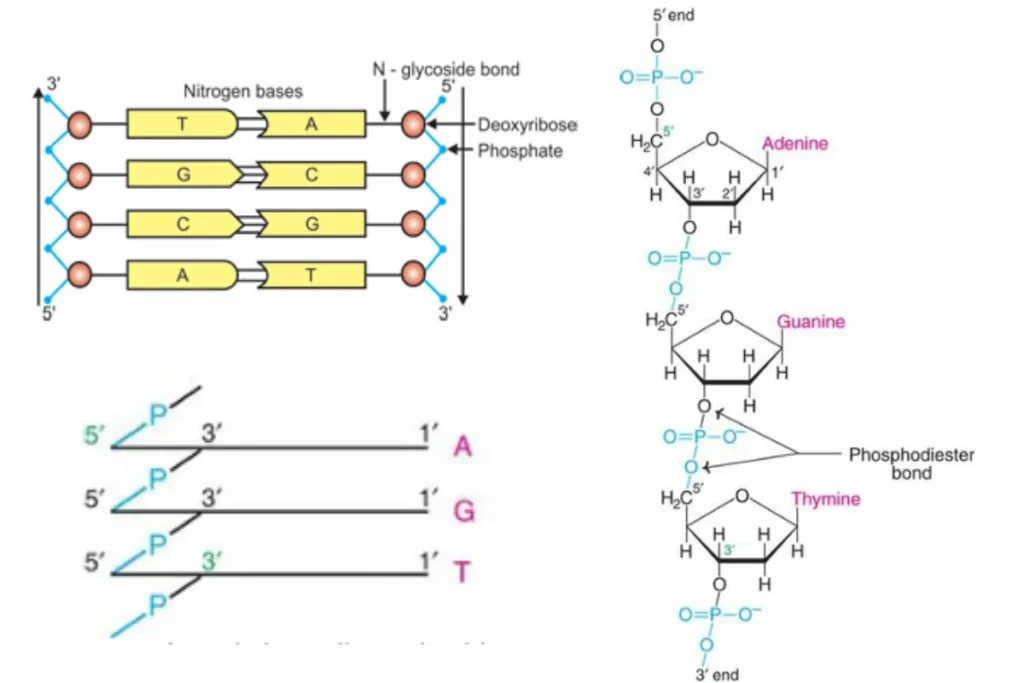
- DNA is a very long, thread-like macromolecule consisting of a large number of deoxyribonucleotides. Deoxyribonucleotide is made up of a nitrogenous
base, a sugar and phosphate group. - The bases of DNA molecules contain genetic information, whereas their sugar and phosphate groups perform an important structural role.
- The sugar in a deoxyribonucleotide is deoxyribose. The purine bases in DNA are adenine (A) and guanine (G).
- The pyrimidine bases present in DNA are thymine (T) and cytosine (C).
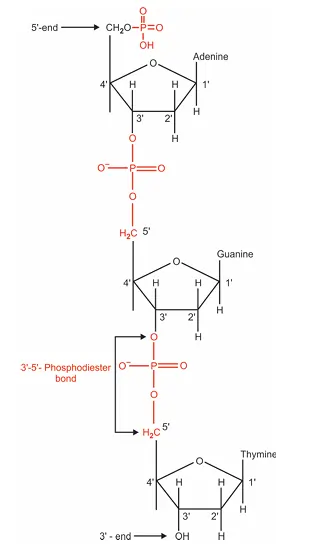
- DNA is a long-chain polymer composed of many deoxyribonucleotides. These nucleotides are covalently connected through 3′–5′ phosphodiester bonds. In this bond, the 3′-hydroxyl group of the sugar in one nucleotide joins with the 5′-hydroxyl group of the sugar in the next nucleotide, forming a phosphodiester linkage that connects the nucleotides together.
Watson and Crick Model of DNA
Discovery of DNA Structure
The deoxyribonucleic acid double-helical structure was proposed by James Watson and Francis Crick in 1953. Their work was a major breakthrough in modern biology and earned them the Nobel Prize in Physiology or Medicine. The structure of DNA resembles a twisted ladder, where the sides are the sugar-phosphate backbone and the rungs are base pairs.
Right-Handed Double Helix
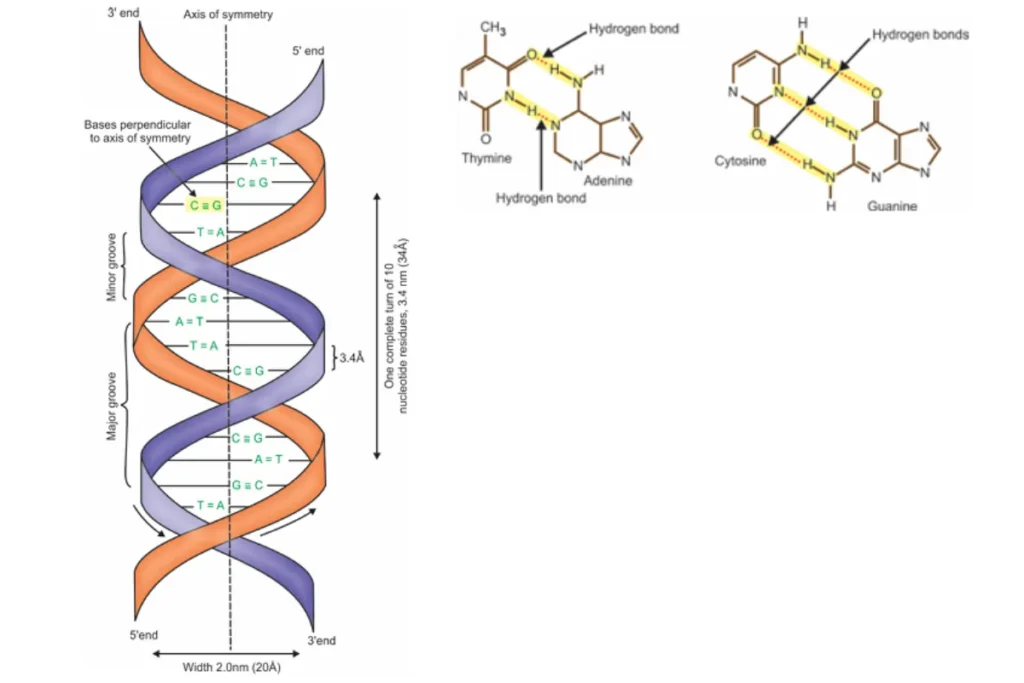
- DNA is a right-handed double helix.
- It is composed of two polynucleotide strands that are twisted around a common central axis.
Antiparallel Strands
- The two strands are arranged in opposite directions.
- One is arranged from 5′ to 3′, and the other is arranged from 3′ to 5′. This is known as antiparallel orientation.
Diameter of the Helix
- The width or diameter of the DNA molecule is 20 Å or 2 nm.
Helical Turn (Pitch):
- One complete turn of the helix measures 34 Å (3.4 nm).
- Each turn of the helix includes 10 base pairs.
- The distance between two consecutive base pairs is approximately 3.4. Å.
Sugar-Phosphate Backbone:
- Each strand of the DNA molecule consists of a hydrophilic backbone of deoxyribose phosphate on the outside. The backbone is held together by a phosphodiester bond.
- The nitrogenous bases are located on the inside of the helix and comprise the core
Complementary Strands:
The two DNA strands are not identical but are complementary to each other due to specific pairing.
Hydrogen Bonding Between Bases:
The strands are held together by hydrogen bonds between complementary bases:
- Adenine (A) pairs with thymine (T) via 2 hydrogen bonds.
- Guanine (G) pairs with Cytosine (C) via 3 hydrogen bonds.
- The G=C pair is 50% stronger than the A=T pair.
Purine–Pyrimidine Pairing Rule:
- Hydrogen bonds occur only between a purine and a pyrimidine base.
- This ensures the helix maintains a uniform width.
- The possible base pairs are A–T, T–A, G–C, and C–G.
Genetic Information & DNA Grooves:
- Genetic information is stored in one strand called the template (sense) strand, while the opposite strand is the antisense strand.
- The DNA helix has two types of grooves:
- Major groove (wide)
- Minor groove (narrow)
- Many DNA-binding proteins interact with these grooves without breaking the base pairs.
Chargaff’s Rule
- Erwin Chargaff discovered that the total number of purines equals the total number of pyrimidines in DNA of any species (A+G=T+C). He also discovered that the amount of adenine equals the amount of thymine and that the amount of guanine equals the amount of cytosine.
- Adenine pairs specifically with thymine, and guanine pairs specifically with cytosine, due to hydrogen bonding and structural compatibility, as was shown in detail in the Watson and Crick model. This means that adenine cannot pair with cytosine, and guanine cannot pair with thymine.
- Consequently, in double-stranded DNA, every pair of bases will contain one purine and one pyrimidine. Therefore, A will be equal to T and G will be equal to C.
- Thus, the ratio of purines to pyrimidines in DNA is always 1 (G + A : T + C = 1), which is known as Chargaff’s rule.
Conformations of DNA Double Helix:
- The different nucleotide conformational variations give rise to different DNA structures. The DNA double helix has at least six different structures, denoted by letters A through E and Z; among them are B, A, and Z.
- The most common form under physiological conditions is the B-form, also described by Watson and Crick. This has 10 base pairs per turn, a pitch of 3.4 nm, and a width of 2 nm.
- The A-form is also right-handed, but it contains 11 base pairs per turn. Its base pairs are tilted about 20° away from the central axis, giving it a more compact appearance.
- The Z-form (Z-DNA) is a left-handed helix with 12 base pairs per turn. The polynucleotide strands adopt a distinctive zig-zag pattern, which is why it is called Z-DNA.
- The Z-form, also known as Z-DNA, is a left-handed helix with 12 base pairs per turn. The strands in Z-DNA take a zig-zag form, hence the name Z-DNA.
- Transitions between these helical structures are believed to be important for controlling gene expression.
Other Types of DNA Structure
Now it is known that DNA is not found in the ordinary form of a double helix. There are several unusual structures of DNA. The unusual structures of DNA are known to be involved in the recognition of DNA by proteins and enzymes. This is important for the proper functioning of DNA. The following are some of the important unusual structures of DNA.
Bent DNA
Under normal conditions, regions of DNA that contain adenine-rich sequences, also called A-tracts, are straight and rigid. However, when these regions are replaced by other bases or when the double helix collapses into the minor groove, DNA can be bent. In addition, DNA can be bent through photochemical damage or through improper base pairing. Some anticancer agents, such as cisplatin, also cause DNA bending. These distortions enable proteins that recognize damaged DNA to bind to the molecule.
Triple-Stranded DNA
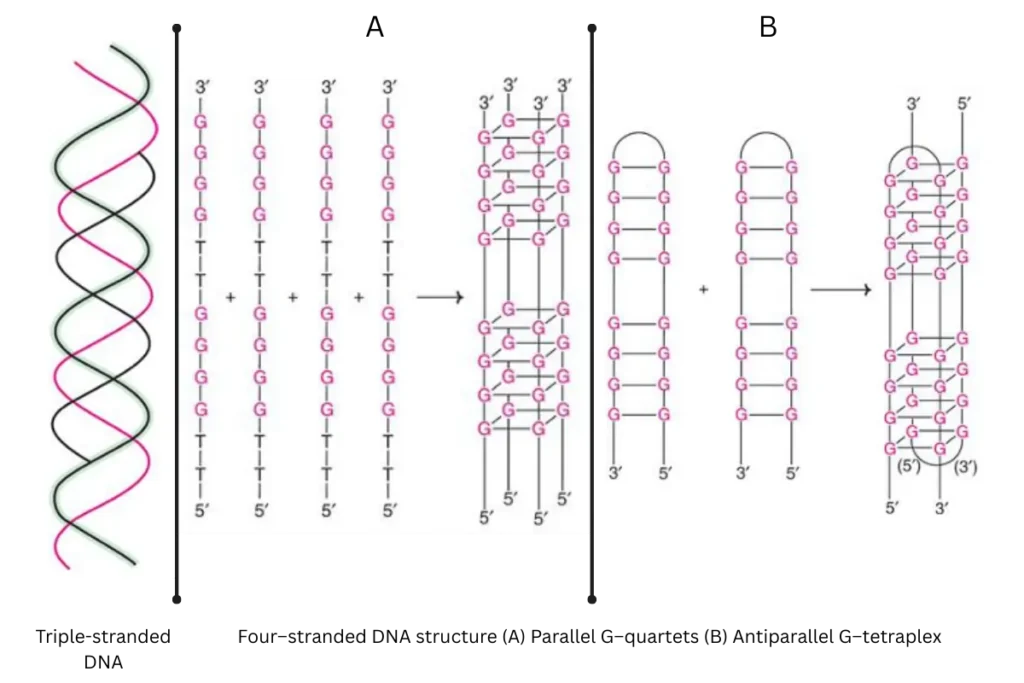
In some instances, the formation of a triple helix is a result of the formation of more hydrogen bonds. For example, a thymine base can form two Hoogsteen hydrogen bonds with the adenine of an A-T base pair to form a T-A-T triple helix. A protonated cytosine can form two hydrogen bonds with the guanine of a G-C base pair to form a C-G-C triple helix.
However, the stability of the triple helix is less compared to the stability of the normal double helix due to electrostatic repulsion. This is because the backbone of the triple helix has three strands that are all negatively charged.
Four-Stranded DNA
DNA sequences with a high guanine content can form special four-stranded structures known as G-quartets. These structures are flat and stabilized by Hoogsteen hydrogen bonds between guanine bases. In some cases, these quartets can organize into larger structures called G-tetraplexes, which may form in parallel or antiparallel arrangements.
The ends of eukaryotic chromosomes, known as telomeres, contain guanine-rich sequences and can therefore form G-tetraplex structures. Because of this property, telomeres have become important targets in modern anticancer therapies.
G-tetraplex structures are also thought to play roles in biological processes such as the recombination of immunoglobulin genes and the dimerization of double-stranded genomic RNA in the human immunodeficiency virus (HIV).
Functions of DNA
DNA is the store of genetic information. The genetic information stored in the DNA serves two functions.
- It is the source of information for the synthesis of all protein molecules of the cell
- It provides the information inherited by the daughter cells or offspring.
Organization of DNA
Prokaryotic DNA
Prokaryotic cells usually contain a single chromosome made of double-stranded circular DNA with more than 4 × 10⁶ base pairs. Because DNA molecules are very large, they must be specially organized so that they can fit inside the cell.
In E. coli, the circular DNA molecule is supercoiled and attached to a core composed of RNA and proteins, which helps maintain its compact structure.
Chromatin Fiber:
The chromatin is made of repeating units of nucleosomes. The units are connected to one another to form a long chromatin fiber.
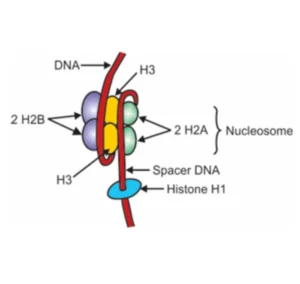
There is spacer DNA between the nucleosomes. This spacer is stabilized by histone H1. The string of nucleosomes is called the “beads on a string,” or 10 nm, chromatin fiber.
Eukaryotic DNA:
This is because a eukaryotic cell has over 1,000 times more DNA than a prokaryotic cell.
The normal cell of a human being has 46 chromosomes, and the total length of DNA present in one cell is two meters. This has to be compacted almost 10,000 times into the nucleus.
The material present in the chromosomes of non-dividing cells of eukaryotes is referred to as chromatin, which is mostly made up of nucleosomes.
Different Levels of Organization of Eukaryotic DNA
Nucleosomes:
Nucleosomes are the fundamental structures of chromatin, consisting of a DNA helix wrapped around a histone protein.
Histone proteins are of five types: H1, H2A, H2B, H3, and H4. Two each of H2A, H2B, H3, and H4 combine to form a histone octamer, which serves as a core.
DNA makes a loop of nearly two turns and is wrapped around the histone octamer, forming a nucleosome core particle, or a “bead”.
Solenoid Structure:
Further compaction is achieved when the 10nm chromatin fibers twist to form a thicker 30nm fiber, which forms a solenoid structure. In the solenoid structure, there are six nucleosomes per turn.
The solenoid fibers are then coiled to form a supercoiled structure, which forms loops with a diameter of 300nm, leading to the formation of condensed chromosomes.
Frequently Asked Question About DNA Structure
What Does DNA Stand For?
DNA stands for Deoxyribonucleic Acid. It is the hereditary molecule that stores and transmits genetic information in living organisms. DNA contains the instructions required for cell growth, development, reproduction, and protein synthesis.
Where Is DNA Located?
In eukaryotic cells, DNA is mainly located in the cell nucleus where it forms chromosomes. Small amounts of DNA are also present in:
- Mitochondria (mitochondrial DNA)
- Chloroplasts in plant cells
In prokaryotic cells such as bacteria, DNA is found in a region called the nucleoid, which is not enclosed by a membrane.
Who Discovered the Structure of DNA?
The double-helix structure of DNA was discovered in 1953 by James Watson and Francis Crick. Their model was based on crucial experimental data obtained from Rosalind Franklin’s X-ray diffraction studies and Maurice Wilkins’ research.
Key points of the discovery:
- Revealed DNA as a double-stranded helix
- Showed complementary base pairing
- Explained how DNA can replicate and store genetic information
What Monomer Subunits Make Up the DNA Polymer?
DNA is a polymer composed of repeating monomer units called nucleotides.
Each DNA nucleotide consists of three components:
- Deoxyribose sugar
- Phosphate group
- Nitrogenous base
The four nitrogenous bases in DNA are:
- Adenine (A)
- Thymine (T)
- Guanine (G)
- Cytosine (C)
These nucleotides are linked together by 3′–5′ phosphodiester bonds, forming a long polynucleotide chain.
Where Is DNA Found?
DNA is found in almost all living organisms, including:
- Animals
- Plants
- Bacteria
- Fungi
- Protists
Within cells, DNA is mainly located in:
- Chromosomes in the nucleus
- Mitochondria
- Chloroplasts (in plant cells)
What Is Recombinant DNA?
Recombinant DNA (rDNA) refers to a DNA molecule formed by combining genetic material from two or more different sources.
Scientists create recombinant DNA using genetic engineering techniques.
Common applications include:
- Production of human insulin
- Development of genetically modified crops
- Gene therapy research
- Production of vaccines and therapeutic proteins
What Shape Is DNA?
DNA has a double-helix structure, often described as a twisted ladder.
Key structural features:
- Two antiparallel polynucleotide strands
- Sugar-phosphate backbone on the outside
- Nitrogenous bases paired in the center
Base pairing rules:
- Adenine (A) pairs with Thymine (T)
- Guanine (G) pairs with Cytosine (C)
These base pairs are held together by hydrogen bonds, stabilizing the helical structure.